Jump to content

Canyon Vs Silverado.....canyon Wins


Recommended Posts

Posted

OK, we made a trip home last weekend, from Pascagoula, MS to Charleston, SC across the panhandle of Florida, I10, pretty flat ground, we pushed it real hard (running double digits over the speed limit) and both trucks were loaded with around 600 to 700 LBS, we filled both trucks at the same station and with the same gas pump both times, here are the results.


Miles Driven (both trucks) 359 (average between both trucks and the GPS).


2006 GMC Canyon took 16.05 Gallons to refill, resulting in 22.4 MPG


2008 Silverado took 21.36 Gallons to refill, resulting in 16.8 MPG


Now both trucks usually give us better mileage, we were driving them hard at 80+ MPH (my GPS showed an average speed of 74.6 MPH even with construction zones)


But the main point is that the Canyon delivered almost 6 MPG better even when loaded and driven the exact same way.


I have more details and pictures if anyone wants it.


By the way as a side note, my DIC showed an average MPG of 17.6 instead of the actual 16.8.


And please don't think that I am bashing my Silverado, I love the comfort and the ride but so many people say that the fullsize trucks beat thye midsize trucks in fuel mileage and I just wanted to give real world data istead of hearsay from a "friend who owns one"

Posted

I bet if you went the speed limit you'd get even better milage. Not sure why you would be suprised that a small truck would get better mpg's than a full size. Slow down, save a life (maybe your own?).

Posted

Not so sure I'd call that a "WIN" but to each his own. I wouldn't trade my Sierra for a Canyon if it got 40 mpg. They are just made for two different markets. I'm sure both are good vehicles.

Posted

Nice test... but I agree with other... I'd take the Silverado any day over the Canyon regardless of mileage for most trips. If you had to do an emergency stop, I'd bet the Silverado would handle it alot better.


Cool comparison though and good info.

Posted

At first I thought this was going to be a thread about which truck did/did not make the journey.


I bet if towing a large, heavy trailer the Silverado will eventually start to take the win ... in MPG comparisons.

Posted

:cool:


Of course the Canyon got better mileage. And I bet an Aveo would beat the Canyon.


No one here drives trucks to get good mileage. We need and/or like driving trucks.

Posted

Yep, I agree, the Canyon is supposed to get better mileage, but I also would not want to give up my Silverado, mainly for towing reasons though.


The test was simply to see how much better the Canyon would do, that to me was the big surprise, after reading post for a while now as to how the midsize trucks get horrible mileage, I just wanted to share exactly how much better the mileage is in the smaller trucks.


And by the way, when gas gets back up to $4 we will all be talking about mileage again. (Hopefully that won't happen)


Anyway, no comments on the DIC not being accurate?

Posted
Yep, I agree, the Canyon is supposed to get better mileage, but I also would not want to give up my Silverado, mainly for towing reasons though.


The test was simply to see how much better the Canyon would do, that to me was the big surprise, after reading post for a while now as to how the midsize trucks get horrible mileage, I just wanted to share exactly how much better the mileage is in the smaller trucks.


And by the way, when gas gets back up to $4 we will all be talking about mileage again. (Hopefully that won't happen)


Anyway, no comments on the DIC not being accurate?


You averaged the miles driven between 3 items, that may have been it. Try recalculating based on the miles the truck says it drove.


Also, my truck says I average 15.4 mpg my calculations say 15.1 has always been about that much off from day 1.

Posted
Anyway, no comments on the DIC not being accurate?

Both are good rigs. We're just giving you the business as usual. :cool:


The DIC on my truck currently shows an average of 16.4 over 12000 miles since new. (I think I reset it about 1000 miles or so) The only times I did compare DIC info to actual fuel calculations it was off by as much as .5 MPG. The DIC is only offering an educated guess based on calculations provided by the engine management system. Evaporation, temperature, and other external factors make it impossible to be 100% accurate. I'd say it's pretty darn close.


Shouldn't that be good enough?

Posted
Anyway, no comments on the DIC not being accurate?


To me that is not that big of deal. I don't think it is that far off. It is less than a mile per gallon off and that is assuming all the numbers you gave us are dead on, the fuel nozzle shut off at the same time as the previous fill up, and that you reset your DIC immediately after you started your truck after getting gas and not once you already started driving. All of these could play into the differences.

Posted
Yep, I agree, the Canyon is supposed to get better mileage, but I also would not want to give up my Silverado, mainly for towing reasons though.


The test was simply to see how much better the Canyon would do, that to me was the big surprise, after reading post for a while now as to how the midsize trucks get horrible mileage, I just wanted to share exactly how much better the mileage is in the smaller trucks.


And by the way, when gas gets back up to $4 we will all be talking about mileage again. (Hopefully that won't happen)


Anyway, no comments on the DIC not being accurate?


You averaged the miles driven between 3 items, that may have been it. Try recalculating based on the miles the truck says it drove.


Also, my truck says I average 15.4 mpg my calculations say 15.1 has always been about that much off from day 1.


Actually, base it off the GPS. That's the most accurate of the three by a landslide. Your numbers for the vehicles relative to one another won't change, but you'll get a more accurate MPG. The mileage reported by the trucks themselves will be effected by whether you have the original tires on them or not. It can even be effected by how worn the tires are (shortened diameter).


Regardless, it's interesting data.

Posted

You haven't told us anything about the trucks. Canyon has which engine? Your truck has what gears? How many miles does yours have? Canyon also has far less wind resistance.

Posted
You haven't told us anything about the trucks. Canyon has which engine? Your truck has what gears? How many miles does yours have? Canyon also has far less wind resistance.


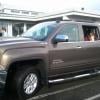
Excellent Questions, The Canyon is a 06 with the 3.7L I-5 and 3.73 Gears, it has stock LT265/75R15 Tires and the Truck has 42K Miles on it, Its a RCSB


The Silverado is a 08 CCSB with the 5.3 L Alum, and 3.73 Gears as well, It has the stock tires as well and currently has 14K Miles on the clock.


Both Trucks are 4 speed Autos.


Both trucks were driven the same speed, both with CC set.


I normally drive much slower, and did on the return trip, but needed to get home as quickly as possibe, driving that fast is not something I like to do at all.


Also My Silverado has a Hood Protector on it that cuts mileage some, I just would rather suffer a little mileage than to deal with all of the bugs on the hood this time of the year.


Oh and Both Trucks belong to me.


DSC_0697.jpg

Archived

This topic is now archived and is closed to further replies.

  • Latest Articles

  • Posts

    • I have ordered the car link adapter and registered for the google dev, will need to finish verification process later this evening when I get ahold of our kiddos android tablet. I will be using windows vs mac so hopefully it goes smoothly. I have zero tech background but I feel I can manage this with your write up.    Do you think it will be different for me? My truck is a 2023 GMC 1500, I have looked heavily into the AI boxes but I consistently find common complaints with lag.    Does carplay auto open now that you have it set up when you get in truck and turn it on? Or do you have to do open the app everytime? 
    • I figured you would know about it.
    • It added a cost layer to an already limited production supply. True that. 
    • Swap costs and supply/demand balance. When a barrel comes out of the ground the entire range of products are present but not all at the same percentage.    Breakdown of Refined Products The following table summarizes the approximate output from a standard 42-gallon barrel of crude oil: Product Type Gallons per Barrel Percentage of Total Gasoline 20 gallons 45% Diesel Fuel 9 gallons 21% Other Products 13 gallons 31%   Most of that diesel figure is 'straight run' or cut from the barrel. Gasoline 'cut from the barrel runs 0 to 20% at the crude. So in the crude unit there is more diesel the gasoline, usually.  The full refining experience however gives the tabled values. Ego there is half the diesel than gasoline after the 'first crack' That could be an FCC unit, or Isomax or....   Those units take heavy products and break the big ones into little ones. Those numbers are harder to get hold of but directionally it ends up the same.    Really light products are very profitable. Ethylene and Propylene to name two. Those are cracked from slightly heavier feeds like NG and Propane and Ethane. The cracker harshness determines the feed for distillation. Those feeds come from less profitable products like diesel and gasoline.    So...there is a swap cost. How much market is there TODAY and what crude am I running TODAY..... what is my process capable of always.    There is this as well. The USA uses allot more gasoline than it does diesel so in the cracker the process is tilted to gasoline production which....limits supply of diesel. OTR uses the most and it has different requirements than automotive and agricultural.  Limiting auto products.    You are correct however. It is less refined, just less of it. Allot less. 
    • Most thermostatically controlled ATF systems use a 'wax' pill just like the one in your water thermostat. They work on the expansion volume of the wax and the pill is constructed in such a way as to limit the travel to remain within that range. This means it has an opening temperature often called the 'cracking temperature' and a fully open temperature. For whatever reason oil is designated by it's fully open temperature and water by it's cracking temperature.    Between the two it the "Regulating Temperature" The entire range is about 20 F from closed to open. In your example the lower limit, opening point of 145 F then has a fully open temp of 165 F and a throttling temperature of 155 F.    Thing is, the throttling temperature needs two things to work properly. Enough system load high enough to reach the minimum and a heat sink (cooler/exchanger) large enough to prevent any load applied from exceeding the fully open temperature.    If your system exceeds the fully open temperature it is screaming MORE COOLER.    Here is the silly part of the whole thermostat system where the oil is cooled/heated by the radiator. Nothing is flowing to that system until the oil temperature reaches the cracking temperature unless it is equipped with a minimum flow bypass orifice or a bypass built into the seating surface of the plunger. That system meant to get it up to temp quicker isn't doing a thing until WORK drives if from ambient to cracking temp. One a cold winter day, like zero F, it may never get hotter than about 110 F. Sometimes not even that.    People forget or are young enough to not know that until this millennia transmissions were cooled by the radiator cold tank alone and without a thermostat at all.  In the 50's they weren't even cooled. OEMs learn everything the hard way.    When an OEM tells you the trans "Works best" between 175 F and 220 F it means works best for THEM. The transmission thermostat is fuel play. If you watch you trans temps like I do you will learn that it may take a hundred miles if you are not towing and not driving more than say 55-60 mph on a zero F day to even reach 120 F and it might sit there all day if it's colder. Yet if functions perfectly over about 100 F. It may need to get a bit warmer for the fuel and spark maps to go without an multiplier.    Worry more about too hot. Use a cooler large enough to put that thermostat in range.         
  • GM-Trucks.com Clubs

  • Popular Contributors

×
×
  • Create New...