

-
Recently Browsing 0 members
- No registered users viewing this page.
-
Forum Statistics
250.5k
Total Topics2.7m
Total Posts -
Member Statistics
342,903
Total Members8,960
Most Online
-
Who's Online 7 Members, 0 Anonymous, 623 Guests (See full list)
-
Latest Articles
-
Posts
-
 Any joy with this truck seems to be short-lived. The CEL for P0172 ("bank 1" too rich) is now "intermittent". I'm not sure where to check, or re-check, and my energy to keep chasing problems with junk is wearing thin. The P0172 seems to set as I'm coming to a stop, completely off the throttle, when fully warm. At least, that's what it's done the 3? times it's set. Everything appears normal on the scanner EXCEPT long term fuel trim. There's only one bank on this vehicle because it's an OBD 1.5 with only one upstream O2 sensor. At idle, it's around -16.4% and will dip to -18% occasionally at idle or off-throttle. LTFT approaches 0 when throttle is held at 2500rpm. Short term appears normal, much closer to zero all the time. The LTFT tells me the engine is running rich at idle but compensating at higher load. But, why? The EVAP purge valve doesn't appear to be leaking/sucking fuel vapor continuously. Is it sticking just as I come to a stop and the engine is choking on fuel vapor and sets the P0172? But that doesn't explain the persistently negative LTFT. Disconnecting the purge valve doesn't seem to make any difference. I suppose that leaves another dang issue with the fuel injector. A leaking fuel pressure regulator, a new leak in the spider, or a leaking fuel injector/poppet valve I didn't see, or a small crack in one of the spider legs. The vacuum line leading to the fuel pressure regulator doesn't have raw fuel in it. It doesn't even smell like fuel when it's pulled off, not until you suck air through it, then you can tell it leads to a fuel component. I'd consider that normal? Nothing is signaling this is a FPR issue from the outside, at least. The oil smells like fuel but it's not building volume. I've noticed most oil in most engines smells like fuel to some degree so it's hard to say if the smell is an issue or not. Or if the engine just still smells like fuel because the crankcase was full of it a few hundred miles ago. But it's been changed twice since that original issue of the leaking fuel line dumping fuel into the intake. Patience is running very thin. Every win seems to be accompanied by two steps backwards, or another issue that leads to removing at least the top half of the intake manifold. Enough! LOL
 -
 First off you mentioned "Toyo Says" and then gave the pressures 45/50, was this some person at the tire shop that pulled those numbers out of his head ? Now of course I can't know your exact axle weights front and rear, however I have much the same pickup as yourself other than not knowing your starting weight as per the pounds the truck rolled out of the factory at due to the options yours did or didn't come with or what you have added beyond the extra tire weight. The correct way to know 100% where a person is at is by weighing each axle with the typical weight the vehicle is driven with and that means taking into account passengers and making sure you figure in a full tank of fuel and a little grace for whatever you may put in the bed "groceries" ! I am looking at and not that it really matters as all the tire companies use the same charts anyway, but I am looking at the comprehensive Toyo tire chart in the section that your tire falls under and I know it sounds confusing but your tire is not an LT metric tire like your factory tire but instead because its a standard inch measured tire its under a different category called an LT floatation series tire. That makes a difference as LT metric tires they don't want to see run below 35 psi at highway speed where as with the LT floatation series it can be run down to 25 psi on the highway as long as the weight on the said size of tire is agreeable with or less than that minimum 25 psi. It blows many people away that how is this physically possible, an empty truck for one thing and larger tires with the same size wheel diameter have a lot more air volume so they can carry the same weight as the smaller tire with less air pressure. So my truck, I have the stock 275/65R20 wheels and tires and I have a bit of weight in the box with a bak flip cover and a rubber bed mat and some tools and spare gas. The front of my gas truck weighs a bit more than some trucks of the similar spec due to double batteries and alternators. However with full fuel and just me in the truck I am weighted such that I can run 40 front and 35 rear and so that is what I have done since day one. If I base your truck at or slightly below the weight of my truck, in theory with your tires going by the tire chart you might be right around a minimum of 30 pounds front and 25 pounds rear. Of course that would hit pretty much minimum cold inflation pressure one could run with that tire size and a near empty truck. If you have access to an accurate weigh scale to do individual front and rear axle weights I would suggest you do that and make sure your topped up with fuel and whatever else in the truck before you weigh it and then you will have a great starting point to work off of and figure out what your bare minimum pressures are you can safely run. If you do much in the way of hot weather high speed driving, bumping up a bit for a safety margin is never a bad idea but just depends on what type of driving you do. I will include the Toyo chart and the floatation series sizes start on page 31. Without a doubt at these pressures I am speculating at minimum wise for your truck, it would most certainly ride very different then it did when you were using 55 lb front and rear. https://www.toyotires.com/media/pxcjubjs/application_of_load_inflation_tables_20200723.pdf
 -
 Take an automotive stethoscope to the vacuum pump. Iirc those tick as well.
 -
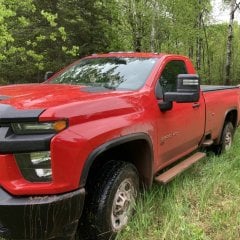 This landing is worse than most. Patchy blacktop with washouts, soft gravel/sand at bottom that washes out with every heavy rain. I tell everyone to put it in 4WD. A lot of them think they can pull out their trailer in 2WD. They end up digging a hole and then putting it in 4WD. The lake is a pristine lake and has a lot of money on it. There are several wake boats and lot of large tritoons. The people with the money don't want it improved because they don't want more traffic. Boat Landing 1.jfif Boat Landing 2.jfif Boat Landing 3.jfif
 -
 How wide are your rims? Toyo specs 8.5-10.0-11.0 inches. My thought would be rim might be pulling the tire inwards creating a center that is more pronounced. I also noticed that the spec sheet says max 65psi. So you could be right lowering the pressure to ~40 psi.
-
-
GM-Trucks.com Clubs
-

Black Truck Club
Open Club · 612 members
-

White Truck Club
Open Club · 380 members
-

Canadian Owners Club
Open Club · 282 members
-

Red Truck Club
Open Club · 158 members
-

diesel 3.0
Open Club · 281 members
-

Texas Owner's Group
Open Club · 371 members
-

NorthSky Blue Club
Open Club · 118 members
-

Midwest Owner's Group
Open Club · 213 members
-

2015 Custom Sport Club
Open Club · 5 members
-

GM Snow Plowing Club HD
Closed Club · 14 members
-
-
Popular Contributors
-
.thumb.JPG.2c573de60d3a3a4407c7d92298db46dd.JPG)


Recommended Posts
Archived
This topic is now archived and is closed to further replies.