
Vicarod
-
Posts
229 -
Joined
-
Last visited
Content Type
Profiles
Forums
Gallery
Events
Articles
RPO
Store
Blogs
Everything posted by Vicarod
-
Look what followed me home
Vicarod replied to BowtieBill's topic in 2019-2026 Silverado 1500 & Sierra 1500
6.2L CC Std Bed: FTW! Nice truck and I suspect not many around in that configuration. -
Changing the brakes on 2020 GMC Sierra 1500
Vicarod replied to Charles Busby's topic in Troubleshooting, Warranty & Recalls
I agree. This forum is filled with people becoming members because they have a problem with a new truck, making a handful of posts because they are looking for an answer , and never coming back. -
8 speed downshift clunk to 1st gear
Vicarod replied to 11bravoZ71's topic in 2019-2026 Silverado 1500 & Sierra 1500
Mine does it. I wouldn't say 50% of the time. I do notice that it happens a lot less after the computer learns your driving habits, if that is such a thing. Dealer did a transmission software update when I took it in for the recalls in September. After that it seems as if I was starting all over again with the transmission. It got better after a while. I have no other issues with the transmission. Very smooth shifting. But I do notice the downshift occasionally. It's these weird shifting characteristics that put people off of the 8spd. Personally I don't blame them. I don't know the failure rates / reasons for these transmissions so don't know if this is an indicator of impending failure. OP welcome to the forum. Hope your dealer can help you get to the bottom of this issue and keep us posted. Also, what is the mileage on the truck and do you know the build date? -
No BS. The considerations I gave were given in the paper itself. Like I said, I'll fwd the paper to anyone else to formulate their own opinion. Too bad you didn't highlight that.
-
Kept thinking about this thread last nite. I feel that my comment was a bit cavalier and didn’t provide enough information into my thoughts on the matter of oil filtration. First, it makes sense that not all filters are the same and that a filter that is capable of filtering smaller particles will reduce the size of those particles in suspension and reduce engine wear. Then I remembered that since the company I work for builds the most beautiful aircraft in the world…I have access to SAE articles. So, I read it this morning. It’s an interesting article, from 1988, but the premise remains the same. The abstract is descriptive, but doesn’t tell the whole story. First off, wear is reduced by reducing size of particles. But is too much of a good thing bad? Possibly in the case of oil filtration. The filter may plug sooner with a finer media, thereby causing more damage. There are other considerations in the paper to be reasoned with. Also note that “Fine Test Dust” was added to the crankcases of the engines to accelerate the engine wear. More importantly, just because this article reduced engine wear by 70% (in some cases) in a test environment results in real world applications will vary from engine to engine. This test was done to correlate oil filtration with engine wear. It was not designed to predict how much longer your engine will last. It can be inferred that your engine will last longer with better filtration. I still agree with UGADawgs. Like I said yesterday. With this one caveat: Pick a quality filter. Do research (if you want to). I have way too many other priorities in my life to get down in the details on engine oil filters. OP, if you are concerned about aftermarket filters, roll with the OEM filter. You can’t go wrong. You can go better (possibly)…but OEM will serve you well. Keep your oil clean, use a quality oil and filter. Enjoy your truck. If anyone is interested in the SAE paper, send me your email. I’ll fwd it to you.
-
I have to agree with this for the most part. I currently run NAPA Platinum in all my vehicles (made by WIX I think) You can usually pick them up at a good price when they are on sale ($7.50 or less)...otherwise they are approx $12
-
Check Your Wheels and Tires!!!!
Vicarod replied to shanemoon's topic in Troubleshooting, Warranty & Recalls
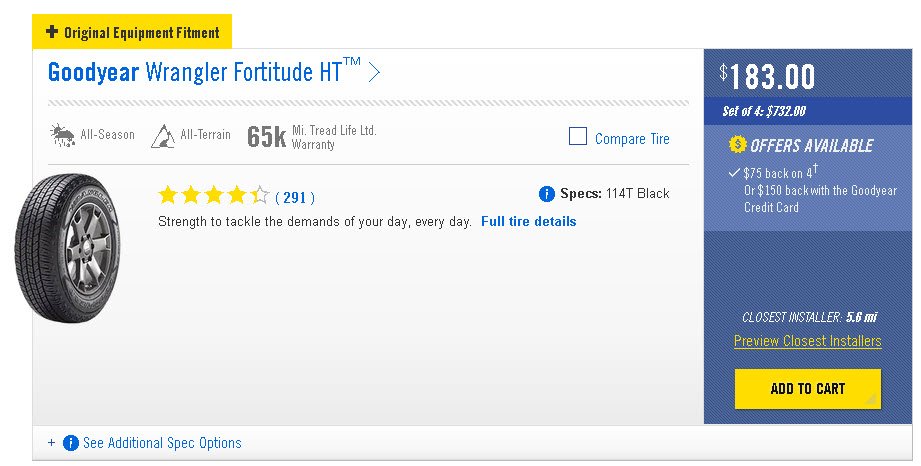
I am not here to defend the capability of the Wrangler Fortitudes, but per Goodyear website, they list it as an All Terrain tire.
-
Changing the brakes on 2020 GMC Sierra 1500
Vicarod replied to Charles Busby's topic in Troubleshooting, Warranty & Recalls
Hey OP, you ever get your brakes sorted? -
Changing the brakes on 2020 GMC Sierra 1500
Vicarod replied to Charles Busby's topic in Troubleshooting, Warranty & Recalls
Bet he put on Powerstops or something like that... -
Hard shift from park to reverse
Vicarod replied to AD80's topic in Troubleshooting, Warranty & Recalls
My truck does this as well...Sadly I think it is a characteristic of the 8spd. I let the truck do a full needle sweep of the gauges before I put it into gear. That usually alleviates the slam into reverse. I think letting the transmission start pumping fluid when first starting -- especially after sitting all night for example -- goes a long way in solving that problem. Other than that, the transmission is smooth. I do believe that it takes a few thousand miles for the transmission to "learn" your driving habits. I am not too clear on that, so if someone else knows, please correct me. All of that to say that I do feel the truck is smoother now with 18k on the clock then when I drove it off the lot with 25 miles on it. -
Extended cabs are cool. My son's 2000 Silverado is an extended cab. Once my kids were big enough, an extended cab didn't work in my world. And since I could also buy a CC with a standard bed...that was the deciding factor right there. Talk about rare...hard to find everything you want in a CC std bed on the lot.
-
Good luck with the Ram. I was at a Scout function with my soon-to-be Eagle Scout this past w/e. Parked my son's truck next to a brand new Ram. Man...those interiors...really something to be said about how much nicer they are than the GM's in my opinion. I don't have an opinion on their durability or how quiet they are...but they do look nice. Glad GM is updating the interiors on these trucks. Not that ours are bad...but you put them side by side...wow.
-
Might be the window frame is cracked.
-
So you just had the TSB fix that reseals the rear window? Or did you have the rear spoiler replaced / fasteners re-torqued / re-sealed? Have you looked at the rear window to see if the frame is cracked? It could be that they are sealing the rear window and the leak is actually coming from the spoiler down to the window.
-
That's GM's official take on it. Complete fluid flush helps the shifting issues of the 8spd. Your transmission already has the correct fluid installed from the factory. If you do experience shifting issues, I wouldn't suspect the fluid. Although that would be the cheapest thing to change. I haven't had any issues with my 8spd yet. What I didn't like was the transmission programming / mapping when it was newer. Weird downshifts and such. After a few thousand miles, that went away. That's a great deal on the 2020 RST. I don't think you will find it much cheaper right now.
-
Welcome to the forum! Time for a center console swap! My RST has the factory center console with the two cup holders and the little "3rd" cup holder between them (think red bull can size) Remember there are two additional cup holders in the rear of the center console (for back seat passengers, but you can use them) If you don't want to do that, I think there are storage solutions that sit on the transmission tunnel between the dash and the seats.
-
Me too. I liked my 2000 Silverado so much I kept it even when I bought my newer trucks. Now it's my son's (except I borrow it all the time)
-
2.7L Oil..Synthetic?
Vicarod replied to ScipElevation's topic in 2019-2026 Silverado 1500 & Sierra 1500
I would think most mfg's call for synthetic nowadays. Not sure, but if i had to venture a guess... Enjoy that new turbo motor, OP and post some pics of your new ride! Do you plan on doing the oil changes yourself? -
If you want the new interior, you'll have to wait until 2022. Your trade won't be as much then. Used truck prices are bonkers right now. It's why I am considering selling my 2019 RST.
-
Front Passenger Window Auto Up Stops Half Way
Vicarod replied to jbr1888's topic in Troubleshooting, Warranty & Recalls
OP has a GMC SLT trim. No auto up on passenger side for the RST. I think LTZ and up trim has the auto up passenger. -
The interior is where most of the refresh will be done. The outside will get mild updates as typical in a mid-cycle refresh. GM is taking a pounding on the interior and it is deserved. Ram and Ford interiors are much nicer, even though the Chevy interior is functional. The anticipation is that the interiors of the trucks will be similar to the 2021 full size SUV's. I've sat in the new 2021 Yukon, and I have to say it's very nice. If GM goes that route, I think a lot of people will be satisfied with the interior.
-
New Owner and New Silverado!
Vicarod replied to BluegrassMotorsport's topic in 2019-2026 Silverado 1500 & Sierra 1500
Good looking new truck. Great engine / trans combo! An added benefit, you get the 6.5' bed! If I had younger kids or none at all, I'd go with a double cab. -
potential new lt trailboss owner need advise
Vicarod replied to jw1595's topic in 2019-2026 Silverado 1500 & Sierra 1500
Congrats on your new truck. Man, I really like those TB's. It also has the safety package on it which is the one thing I wish my RST had. Amazing that dealers aren't ordering these trucks with that option. It's $800 and worth it in my opinion (although it should be standard IMO) Pickup Truck Plus SUV Talk has a video out about the lack of a transmission cooler on the 2019 and up Tundras. Toyota says it just isn't necessary. Agree or not, that's their stance on it. -
Soft Roll Up Tonneau Cover in Canvas that locks?
Vicarod replied to Lyons00's topic in Modifications, Wheels & Tires
Although I don't have one, I found this: https://www.autoanything.com/tonneau-covers/truxedo-sentry-tonneau-cover It looks to be a really nice cover and certainly more secure than the velcro ones that are out there. And it has a canvas cover option. Seems to have some decent reviews. I have only had the cheaper vinyl soft roll-ups. -
Did a couple cheap appearance mods
Vicarod replied to psk256's topic in Modifications, Wheels & Tires
I've been kicking around getting those plastic wheel covers, too. Thanks for posting this. Although...I am on the fence on selling the truck as well so...


-
Forum Statistics
250.4k
Total Topics2.7m
Total Posts -
Member Statistics
342,801
Total Members8,960
Most Online
-
Who's Online 10 Members, 0 Anonymous, 354 Guests (See full list)