
2015 front suspension / steering click pop creak knock rub squeak tap
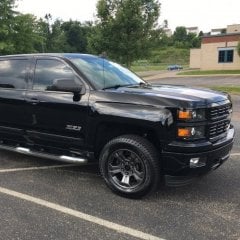
-
Recently Browsing 0 members
- No registered users viewing this page.
-
Forum Statistics
250.5k
Total Topics2.7m
Total Posts -
Member Statistics
342,913
Total Members8,960
Most Online
-
Who's Online 10 Members, 0 Anonymous, 645 Guests (See full list)
-
Latest Articles
-
Posts
-

By Another JR · Posted
Have considered installing a DC to DC charger in your camper to replace your isolator? -
 Common failure. You need to replace the fuel door housing. The painted cover transfers over to the new housing. To remove the old one there is 4 spots where you poke the plastic to release it.
 -
No such thing as regenerative braking on a pure ICE vehicle. Regenerative braking is the re-capture of energy from electric motors and stores it in the battery pack. So hybrids, PHEV and EVs have regenerative braking. What you are seeing is the charging system changing modes is all. Its likely entering charge mode for some sort of reason is all. All of the charging modes will be listed below. As for L10 vs D. L10 turns off automatic grade braking. L10 puts you in control of grade downshifts where in D it will automatically do it based on brake pedal position and other factors. Otherwise L10 and D drive exactly the same aside from that one aspect. Battery Sulfation Mode The BCM will enter this mode when the interpreted Generator output voltage is less than 13.2 V for 45 minutes. When this condition exists the BCM will enter Charge Mode for 2–3 minutes. The BCM will then determine which mode to enter depending on voltage requirements. Charge Mode The BCM will enter Charge Mode when ever one of the following conditions are met: Windshield wipers are ON for more than 3 s. Climate Control Voltage Boost Mode Request is true, as sensed by the HVAC control module via serial data. High speed cooling fan, rear defogger, and HVAC high speed blower operation can cause the BCM to enter the Charge Mode. The estimated battery temperature is less than 0°C (32°F). Battery State of Charge is less than 80%. Vehicle speed is greater than 145 km/h (90 mph) A current sensor malfunction exists. System voltage is determined to be below 12.56 V When any one of these conditions is met, the system will set targeted generator output voltage to a charging voltage between 13.9–15.5 V, depending on the battery state of charge and estimated battery temperature. Fuel Economy Mode The BCM will enter Fuel Economy Mode when the estimated battery temperature is at least 0°C (32°F) but less than or equal to 80°C (176°F), the calculated battery current is less than 15 A and greater than −8 A, and the battery state-of-charge is greater than or equal to 80%. Its targeted generator output voltage is the open circuit voltage of the battery and can be between 12.5–13.1 V. When fuel economy mode is active, the generator is not charging, only maintaining open circuit battery voltage. The BCM will exit this mode and enter Charge Mode when any of the conditions described above are present. Headlamp Mode The BCM will enter Headlamp Mode when ever the head lamps are ON (high or low beams). Voltage will be regulated between 13.9–14.5 V. Start Up Mode When the engine is started the BCM sets a targeted generator output voltage of 14.5 V for 30 s. Tow/Haul Mode (if applicable) Pressing the Tow/Haul Mode button located on the center stack, the vehicle system voltage is raised and the remote (non-vehicle) battery will be charged. Having the headlamps on will raise the system voltage and if the Tow/Haul button is applied it will not serve any purpose. The voltage is regulated between 13.9-14.5 V.
-
 Hello from Australia Just sharing that there is now a way to delete the active shutters entirely with just a plug in module. Opens up tons of room to light bars etc.
 -
 I have an observation and a question... 1) I watch the voltage closely because I have had to dial in the cut-in/cut-out voltages of the battery separator to my camper. The "smart" charging drives me nuts. Anyway, I noticed that when coasting for a while, and especially if lightly using the brakes (though not necessary), the voltage goes up from mid/high-13 volts to mid/high-14 volts. Then it drops back down after stopping or going again. Consistently! The only explanation I can come up with is REGENERATIVE BRAKING! Well, maybe that's a little bit of an exaggeration, but it's certainly free extra battery charging. 2) Driving on mountain roads I will use L and vary the max gear. Things straighten out and I end up in L10. Sometimes I leave it there for a while. Is there any difference between L10 and D?
-
-
GM-Trucks.com Clubs
-

Black Truck Club
Open Club · 613 members
-

White Truck Club
Open Club · 380 members
-

Canadian Owners Club
Open Club · 282 members
-

Red Truck Club
Open Club · 158 members
-

diesel 3.0
Open Club · 281 members
-

Texas Owner's Group
Open Club · 371 members
-

NorthSky Blue Club
Open Club · 118 members
-

Midwest Owner's Group
Open Club · 213 members
-

2015 Custom Sport Club
Open Club · 5 members
-

GM Snow Plowing Club HD
Closed Club · 14 members
-
-
Popular Contributors
-
.thumb.JPG.2c573de60d3a3a4407c7d92298db46dd.JPG)



Recommended Posts
Archived
This topic is now archived and is closed to further replies.