
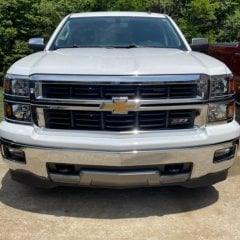
Question- Adding Transmission Cooler, 2014 Silverado 5.3
-
Recently Browsing 0 members
- No registered users viewing this page.
-
Forum Statistics
250.5k
Total Topics2.7m
Total Posts -
Member Statistics
342,944
Total Members8,960
Most Online
-
Latest Articles
-
Posts
-

By richard wysong · Posted
The timing marks are ok, that is #1, you can turn it over until they line up and it won't change anything, the crankshaft turns twice for every camshaft revolution, I have always set up SB Chevs as your pic shows using a straight edge -
 Someone's been here before.... There is a receipt for a 3-piece timing set, purchased earlier this year. Is this picture something, or, nothing? I have the timing cover off and my crank is perfectly TDC and the keyed gear's locating mark is dead on 12 o'clock. The cam gear locating mark is also at 12 o'clock. Now, I'm not an expert, but all the install guides say the two locating marks should meet and be perfectly aligned when installing a timing set. The mark on the crank should be dead on 12:00 and the cam gear's mark should be dead on 6:00, and both marks should be perfectly vertically aligned. I believe the timing gear is keyed or has a dowel that ensures it can only be installed on the cam in one position, so I have to believe the cam is out of phase somehow. At the very least, with a triangular bolt pattern, it can only be installed in one of 3 different positions. Before I pulled the front cover, the truck was running alright, no service engine soon lights except an occasional P0172 / rich condition. Timing -16 timing at idle (should be +16), and total -35% fuel trim, two conditions I haven't been able to figure out. In related news, my injector tested pretty well, wasn't leaking, but I had it rebuilt anyway, and it's on it's way back to me. Along with this discovery, the good and bad: Good: The oil pan seal appears undamaged. Bad: -The timing cover has been reused, and the positioning dowels have been broken. That could explain some of the leaking. -Some kind of white paste or grease was used to try to seal the oil pan seal and timing cover (since wiped off..). -Then, someone globbed silicone all over the front of the cover and also buried the ckp sensor in it. But, they didn't put any inside the cover or use RTV to try to seal the oil pan seal with the timing cover (good).
 -
.thumb.JPG.2c573de60d3a3a4407c7d92298db46dd.JPG)
By Grumpy Bear · Posted
The guy that owns K&P filters last I checked in with him has over 300,000 miles on his Dodge base Hemi using his own 35 micron absolute stainless mesh filter from its first oil change. The GM study I've posted a dozen times shows the relationship in engine life based in multiples of base units, not miles or years. That is the base unit is the number of miles the motor ran using the reference filter efficiency. The above two paragraphs dismantle anecdotal arguments IF one changes oil often enough to prevent particle formation and the motor is in otherwise good shape. That is not full of silica (no air filter) or suffering a metallurgical issue that is not part of the lubrication discussion. Poor heat treat in example. Data from UOA's I've reviewed from more than a few engines can show remarkably broad variations in oil cleanliness using the exact same filter over the course of an engines life. Lastly there is the common sense of it. Wear debris WILL circulate the engine BEFORE it ever sees a filter in route to that filter and WILL harm the pump which NEVER sees filtered oil. Alpha question then becomes, given the facts, how long do you believe is a reasonable service life from a vehicle you are certain you will not pass down? That is the junk yard will be it's resting place when you're done with it? (the moral issue most don't care about). Omega question is then how diligent are you prepared to be in general mechanical, air & oil maintenance? Preventing particulates and keeping them sufficiently dilute; preventing the precursors from generation, amalgamation and precipitation. If I get a good look at the engine bay of a vehicle I have a fair idea of the owners commitment to the inside of the power train. That 30 micron WIX is still more efficient than a sieve. -

By Tyler Gibbs · Posted
It also depends on what criteria someone is using for “best” when talking filters. Are we going off best efficiency? Best quality/QC? Etc. because the two may not mutually exclusive. -
By Tyler Gibbs · Posted
They’re not the same wiz as 10-15 years ago. QC has fallen pretty hard. The XP line was never good though in the first place. https://bobistheoilguy.com/forums/threads/wix-filter-rusted-through.386492/post-6991372 https://bobistheoilguy.com/forums/threads/i-ve-used-my-last-wix-filter.27299/ https://bobistheoilguy.com/forums/threads/looking-for-a-better-replacement-for-wix-51258.403977/ https://bobistheoilguy.com/forums/threads/convince-me-in-using-the-purolator-boss.401537/post-7420147 the forums are littered with posts and examples of not great wix filters the last couple years
-
-
GM-Trucks.com Clubs
-

Black Truck Club
Open Club · 613 members
-

White Truck Club
Open Club · 380 members
-

Canadian Owners Club
Open Club · 282 members
-

Red Truck Club
Open Club · 158 members
-

diesel 3.0
Open Club · 281 members
-

Texas Owner's Group
Open Club · 371 members
-

NorthSky Blue Club
Open Club · 118 members
-

Midwest Owner's Group
Open Club · 213 members
-

2015 Custom Sport Club
Open Club · 5 members
-

GM Snow Plowing Club HD
Closed Club · 14 members
-
-
Popular Contributors
-



Recommended Posts
Create an account or sign in to comment
You need to be a member in order to leave a comment
Create an account
Sign up for a new account in our community. It's easy!
Register a new accountSign in
Already have an account? Sign in here.
Sign In Now