
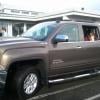
back in a white truck with a TAD more power

-
Recently Browsing 0 members
- No registered users viewing this page.
-
Forum Statistics
250.5k
Total Topics2.7m
Total Posts -
Member Statistics
342,920
Total Members8,960
Most Online
-
Who's Online 8 Members, 0 Anonymous, 1,160 Guests (See full list)
-
Latest Articles
-
Posts
-
 I have a basic 2026 1500 WT (2.7L/4WD reg cab shorttbed). Comfy, generally happy with electronics/radio - but is there a way I can add switches to steering wheel right-side position (curr. empty) so I can adjust volume, push phone button to voice dial, etc? Bill W San Jose
 -

By Tyler Gibbs · Posted
The curb weight on a 1 ton crew cab long bed is around 7k lbs. Now, I don't know where you went to school but 9k is not more than 2x 7k lbs. More than 2x 7k lbs would be 14k+. With that said, obviously yes you're going to feel a 9k lb trailer when slowing down. I already said, when accelerating. When changing lanes? No. But if you look at the context of what was quoted, the original person said, "after a mile or two..." which means that would be after the accelerating portion and you're driving a generally steady pace. Please do learn to read and comprehend. -
 So I purchased the Range unit for my 2026 and I am seeing different locations suggested for the ECM . Can anyone confirm wither under hood, left side or right side or behind the wheelwell?
 -

By No F-bdy Bs · Posted
Like I've said before. Di and Carbon buildup is not that big of a concern. Engine had minimal buildup, and that engine was obviously not super well maintained. Do regular oil changes, and you're gtg as long as the rest of the truck lasts. Also, the High Pressure FP that people ****** about, but can't tell you why. Now, I wish they'd trash the variable oil pump. No real world issues with them, but I'll gladly eat whatever miniscule MPG it's saving me in favor of more oil at all RPMs. Curious to see his assessment of the 7.3 compared to the 6.6. I expect he'll praise the port inj, but from a structural standpoint, the 6.6 is as robust as any engine out there. Not to take away from the 7.3. I feel it's equally as good as the 6.6. As to heat on the rear cyls, I'd have to see numerous examples before I'd say it's an issue. Especially not knowing the history of that engine. For all is known, they could have blown a rad hose, and ran it hot, and the 2 rear cyls may be the first to get hot in a low coolant situation, but not be an issue aside from that. -
 "Life is getting back to normal." I'm driving again and all new joints are operating as expected for this stage of recovery. My most recent joint replacement still requires a lot of attention but experience has taught me that time will quiet the remaining pain. I joked with my surgeon that another joint replacement would take my mind off my most recent surgery and he responded by saying the next will be a hip! There are no plans for another surgery but, unlike me, I don't think he was joking! I certainly wouldn't refuse further replacement if required but hope to spend time out of the "post-op" period. I can't stress enough that if you have been recommended for total hip, knee or shoulder replacement that you welcome the offer. Post-op "recovery" may sound daunting and painful, however, this is far better than the insidious erosion of mobility you are currently experiencing. Imagine what it would feel like to wake up most mornings feeling better and more mobile than you did the previous day! Prior to my first surgery in June 2025, even getting out of bed was becoming a formidable task. Since the day after my first surgery, I get out of bed everyday easily and unassisted. Making the switch to feeling a little better each day rather than a little worse, is hugely motivating!
-
-
GM-Trucks.com Clubs
-

Black Truck Club
Open Club · 613 members
-

White Truck Club
Open Club · 380 members
-

Canadian Owners Club
Open Club · 282 members
-

Red Truck Club
Open Club · 158 members
-

diesel 3.0
Open Club · 281 members
-

Texas Owner's Group
Open Club · 371 members
-

NorthSky Blue Club
Open Club · 118 members
-

Midwest Owner's Group
Open Club · 213 members
-

2015 Custom Sport Club
Open Club · 5 members
-

GM Snow Plowing Club HD
Closed Club · 14 members
-
-
Popular Contributors
-
.thumb.JPG.2c573de60d3a3a4407c7d92298db46dd.JPG)




Recommended Posts
Archived
This topic is now archived and is closed to further replies.