
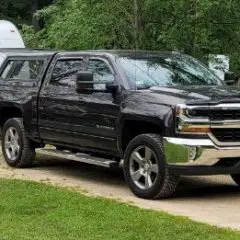
Alignment specs after level 2016 Silverado
-
Recently Browsing 0 members
- No registered users viewing this page.
-
Forum Statistics
250.5k
Total Topics2.7m
Total Posts -
Member Statistics
342,962
Total Members8,960
Most Online
-
Who's Online 3 Members, 0 Anonymous, 1,276 Guests (See full list)
-
Latest Articles
-
Posts
-
 Thanks for all the help so far! I did try right from 2026 right down to 2021, and only from 2023 down lets me select the option for tire psi change, but I get the vehicle not supported error! I'll definitely try it under Chevrolet after work today, and I'll get the sensor number from gm for my truck tire sensors. And I'll let you know if it works for me under Chevrolet! And if that doesn't work, I'm going to guess that what @Atlas said about maybe I have a different body control module could be true!
 -
 From where I'm sitting this sounds like a compatibility problem. I'm assuming the 2007 was a 900-series truck, and not an 800-series (they were sold side-by-side in dealerships that model year), since it starts and runs. This is why I HATE post-2006 vehicles. Everything becomes a huge problem when you try to keep the thing running for longer than the manufacturer has designed it to. I can't remember when Global-A architecture started - either '10 or '11. For your sake, you had better hope it's '11, or you're going to be spending some BIG money to correct this cluster-eff. That's something you need to find out before doing anything else. You may have several computers bricked ... but the fact that it runs tells me you MIGHT be ok here. EDIT: Just did a quick refresher. You're screwed. This is Global-A. The 2 systems are NOT compatible in the slightest. Once you get the correct engine in there that IS compatible, you're going to need to see how many computers are locked. Absolute NIGHTMARE to straighten out, too. Your buddy might be better off cutting his losses and finding something else. Welcome to post-2006 vehicle electronics. This is why I quit the industry, and drive nothing built after 1994. This stuff takes all the fun out of wrenching!
 -
 Recently acquired new 2026 Silv. 1500 WT - L3B + 4WD, std cab + std bed, in (duh!) Sierra White. Upgrades: replaced 'steelies' w/ Vision "Flow" black alloys, 17x8.5"; HDX nerf bar w/steps (black powdercoat); Weatherguard large/deep alloy saddle toolbox; Michelin fitted bedmat (sale, perfect fit) Weathertech door sill guards TBD: rear wheebox liners 4x black fender arch trim - searching for best (Putco: chrome only; not looking for flares either!) -Bill
 -
 True, hard to say what differences there may or may not be between Chev and GM as well as a production year or mid year part change either. I just found it odd that under the Sierra choice on the Autel that many of the last few years of production year did not include the choice of changing the tire pressure but if that is an Autel thing or a GM thing as to why the choices were not there. Knowing what tpms sensors are on the truck should give some guidance into which choices on the tool even make sense to try as I wouldn't give up just yet with the tool but I guess he will see what if anything he comes up with if he finds out a bit more info and tries a few more things on the Autel.
 -
 I'm sure if you went to a junkyard where you go in and pull the part off the truck yourself, not a used part place where they do it for you, you can get that part on it's own. Depending on if and what else you would be buying, and time of day, they might even just skip over adding it as a item to the bill.
-
-
GM-Trucks.com Clubs
-

Black Truck Club
Open Club · 613 members
-

White Truck Club
Open Club · 381 members
-

Canadian Owners Club
Open Club · 282 members
-

Red Truck Club
Open Club · 158 members
-

diesel 3.0
Open Club · 281 members
-

Texas Owner's Group
Open Club · 371 members
-

NorthSky Blue Club
Open Club · 118 members
-

Midwest Owner's Group
Open Club · 213 members
-

2015 Custom Sport Club
Open Club · 5 members
-

GM Snow Plowing Club HD
Closed Club · 14 members
-
-
Popular Contributors
-


.thumb.JPG.2c573de60d3a3a4407c7d92298db46dd.JPG)

Recommended Posts
Create an account or sign in to comment
You need to be a member in order to leave a comment
Create an account
Sign up for a new account in our community. It's easy!
Register a new accountSign in
Already have an account? Sign in here.
Sign In Now