Jump to content

Recommended Posts

Posted

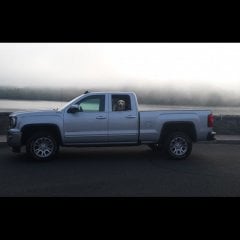
I just got back from a 2 week snowmobile trip in Quebec.  I left my truck at my house in Vermont.  Got back, and the battery is totally dead.  Would not jump off of jumper cables.  Had to call AAA, and they double jumped it with a jump box, and jumper cables.  Drove it home 3.5 hours to my house in CT.  Shut it off, and sure enough, it wont start.  Put a voltmeter on it and is reading 3.3 volts.  So I bought a new battery.  Now I have a warning to service parking brake and a wrench symbol on the dash.  WTF GM??  Off to the dealer I go, and I'm out of warranty as the truck has 40k miles on it.dash.thumb.jpg.55d469bf32e3b7d560adefecaf244e8d.jpg

Posted

Do you have an OBD2 scan tool?  Might be able to clear those codes that are throwing the dash lights.  If they come back on you'll know there's a definite problem. 

Posted

Just saw a video on youtube.  To clear this, just start the truck, press the brake, and hold the parking brake button for 10 seconds.  It cleared.  No trip to the dealer.  But still, batteries dying cuz the truck sat for a couple weeks.  This is the second time it happened actually.  Went on a cruise for a week, came home and same thing, but that time I was able to jump it off my car.

Posted

Have the battery load tested.  Makes me wonder if you have a dead cell in it and the battery is showing enough volts across the good cells when charged but as soon as any load is on it battery drains down and fails


Also, with everything on modern vehicles having sensors and/or being electronic when the working voltage gets low all kinds of weird things happen and goofy errors happen.

  • Like 1
Posted
16 hours ago, AJMBLAZER said:

Have the battery load tested.  Makes me wonder if you have a dead cell in it and the battery is showing enough volts across the good cells when charged but as soon as any load is on it battery drains down and fails


Also, with everything on modern vehicles having sensors and/or being electronic when the working voltage gets low all kinds of weird things happen and goofy errors happen.

Spot on. I just went through this on my '20 Traverse. Load test showed battery borderline weak. Tossed all kinds of crazy codes on a cold start up yet cranked up strong. One would expect more than a few years out of a big AGM battery but not today. 

Posted

Eh, manufacturing defects/COVID production issues/the high demand on the electrical systems of modern vehicles/GM probably didn't put in the highest grade batteries/etc.  He's also in a cold climate with a diesel.  Lots of demands on modern batteries and charging systems.

Posted

Any accessory devices (radar detector, dashcams, etc.) connected that might increase the parasitic draw above the factory level? 


If not, there is a procedure to determine whatever it is that is causing the abnormal draw.


Posted

There was a TSB on something that was causing parasitic draw from the factory because it wasn't going to the proper shut down state and was sticking in standby mode. It's also helpful to randomly put a battery charger on the truck to top it off. If you're driving short distances and the vehicle sits a lot, it will drain the battery and never get fully charged.

Posted

What GETGONE said.  I had this issue on an F150 a while back.  It was a control module that never shut off properly.  We spend months hunting a parasitic drain only to find the transmission said awake all the time and drained the battery.  No faults thrown.  


Good luck.

  • 5 months later...
Posted

Mine is at the dealer right now being tested for battery drain but the dealer is telling me if these trucks sit for 2 or more weeks the battery will be dead and to use a maintainer if it's going to be sitting for awhile. The only thing I have on mine is a dash cam in which has motion recording so I'm sure that's part of the problem but when it's sitting in my closed garage for a couple of week there isn't any movement to record but it's thinking about recording I guess. It has died 2 times, first time after sitting for a month in my garage the battery was so dead it wouldn't even take a charge, the second time it sat outside for 6 days, it started right up, I drove it home (12 miles on highway) and put it my garage and it sat for another 6 days and it was dead again, I was able to charge the battery this time though. I will report back as to what the dealer finds but I'm guessing they'll find nothing besides my dash cam.

Posted

That’s BS. My truck is 5 years old with 113,000 miles on it. Original battery. In February it sat for over two weeks and started just fine. 
 

A newish, correctly functioning, factory original truck shouldn’t have any draws that would make a battery go dead in 2 weeks. 

Posted

Dealer said there is no above normal draw on battery, let it sit 2 days on a meter of some sort. I do agree with it should be able to sit longer than 2 weeks but I'm friends with the service manager at this dealer, I trust him and he said he's had a few of them come in with the same issue and they see no draw on the vehicle. My 2014 Corvette can only sit 3-4 weeks max without a maintainer otherwise it will be dead as well. Not much more I can do, If it's going to sit more than a week going forward I'll just put the maintainer on it. 

Posted

Oh, another thing to add, he said it's just on the refreshed trucks, my 19 didn't have that issue either. 

  • 6 months later...
Posted

Reviving this thread.  Again went on a 2 week snowmobile trip to Quebec, and again came homee to a dead battery.  Had to replace the battery in 4 degree weather in my driveway, that was fun.  It had been at the dealer for 5 days now.  They say there is a parasitic draw somewhere behind the dash.  Anyone have any insight so I can point them in the right direction?  All I can say is this truck has been nothing but a nightmare.  58k miles and it has been at the dealer 5 times now.

Create an account or sign in to comment

You need to be a member in order to leave a comment

Create an account

Sign up for a new account in our community. It's easy!

Register a new account

Sign in

Already have an account? Sign in here.

Sign In Now
  • Latest Articles

  • Posts

    • Did have to make 1 modification because of the WeatherTech rear mud flaps and that was needing 3 longer screws than what came with the install package. 😄
    • Picked up the liners yesterday. Installed passenger side WITHOUT any modifications. All mounting holes lined up perfectly. Rain is interfering today with drivers side. Very Happy! Will add pics when finished
    • As a matter of amusement I’ll leave this conversation with this. Do you beat the government average fuel estimate? Statistics are a guide to me. Not a rule. Someone once said I have to have the last word. If true and possible may be. I’ll blame that on working in a family business.
    • That is a fair point, and I agree that trying to log “everything in the truck” would be the wrong direction.   There are a lot of modules and a lot of traffic. If the product became a full-truck datalogger, the amount of data would get huge very quickly, and most owners would never use it.   I think the first useful version would need to be narrow: - powertrain-side event evidence - selected high-value parameters - communication / voltage / reset events - pre/post event window - short report first, raw log only as backup   One distinction I should make is between active OBD/PID polling and passive bus capture. If you are polling PIDs through OBD, then yes: the more parameters you request, the lower the effective sample rate becomes, and you are adding diagnostic traffic to a vehicle that is already busy running itself. With passive CAN capture, the recorder is not asking all the modules for data. It is listening to traffic that is already on the bus. So it does not consume vehicle bus bandwidth in the same way that a scan tool polling hundreds of PIDs would. But your point still applies in a different way.   Even if passive capture does not add bus traffic, the recorder still has limits: - processing rate - storage rate - timestamp accuracy - decoder workload - event filtering - report size - user attention span   So the answer cannot be “log everything and let the user figure it out.” The product would need to store enough raw evidence to be useful, but only decode, graph, and present the important parts around the event.   A practical report should probably show: - what triggered the capture - how much pre/post data was preserved - which selected parameters changed - how those values compared to baseline - whether the same pattern happened before - whether any voltage, reset, bus-off, lost-message, or communication fault occurred - selected graphs around the event - raw data only as supporting evidence   So I agree with you. More data is not automatically better. The real product is the reduction from raw data into a useful event report.
    • That makes sense, and I agree with most of that.   I think the product would need both: 1. a default powertrain template, so it is useful out of the box; 2. user-selected priority parameters, so the owner or shop can choose what they want to see first.   Different users are going to care about different things. One owner may care about oil pressure and voltage. Another may care about misfire trend, AFM/DFM behavior, or U-codes. A shop may want communication events and repeatability first. Your baseline point is probably the most important one. Raw data is not very useful unless the report can show what normal looked like for that vehicle under similar conditions.   The way I would think about it is: - start with a basic known-good baseline - learn normal behavior for that specific vehicle over time - allow the event to be overlaid against baseline - show whether the event was a one-time spike or a repeatable pattern - provide a simple severity level, but with clear limits on what that severity means   For example, early severity could be something like: - Info: event captured, no obvious abnormal pattern - Watch: value moved outside baseline, but not repeated - Warning: repeatable abnormal pattern under similar conditions - Critical: communication loss, voltage drop, bus-off, reset, or severe repeated event   I would not want the first version to say “replace this part.” That would be overclaiming unless there is repair-confirmed data behind it. It would be more honest to say “this pattern deserves inspection.”   On the OBD port question, I think OBD absolutely has a role. OBD is probably the right place for: - DTCs - freeze frame - VIN - calibration information - normal scan-tool parameters - Mode 6 / enhanced diagnostic data if available The reason I am still looking at an ECM-side recorder is that the failure may happen before anyone connects a scan tool. If the owner plugs in a scanner after the event, the pre-event evidence may already be gone unless the ECU happened to save it. So I do not see this as “OBD versus ECM-side.” I see it more like: - ECM-side recorder: always armed, rolling buffer, event evidence - OBD/DLC companion: DTCs, freeze frame, VIN, calibration, normal scan data - phone/cloud: status, notes, upload, report generation, notifications   I agree that phone connection and push notifications would be useful. I just would not want the phone or cloud connection to be required for capture. The recorder should save the event locally even if the phone is not connected. The phone should help with event marking, download, notes, upload, alerts, and report viewing.   For a default GM V8 event report, would this list make sense? - RPM - calculated load / MAP - throttle position - vehicle speed - gear / torque converter state if available - coolant temperature - oil pressure - oil temperature if available - battery voltage - commanded AFM/DFM state if available - actual AFM/DFM state if available - misfire counters / roughness by cylinder if available - fuel trims - relevant U-codes / communication events - bus-off / lost periodic message / module reset / voltage drop events Which of those would you remove, and what would you add?
  • GM-Trucks.com Clubs

  • Popular Contributors

×
×
  • Create New...