
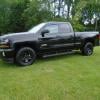
No GM certified Cold Air Intake for the 5.3 2017 Silverado 1500???
-
Recently Browsing 0 members
- No registered users viewing this page.
-
Forum Statistics
250.5k
Total Topics2.7m
Total Posts -
Member Statistics
342,922
Total Members8,960
Most Online
-
Who's Online 9 Members, 0 Anonymous, 1,438 Guests (See full list)
-
Latest Articles
-
Posts
-
I have A 2020 1500 5.3 8 speed. LTZ. Transmission problems since 60,000 miles. Started when I go to store in morning to get my morning coffee before work leave truck running get back in put it in drive/ rev no movement step on gas a little slams into gear. Put in neutral step on gas little shake then put in gear and gose. Shut truck off start .. ok now at stop light stop truck after a few seconds feel a little kick if that doesn’t happen stuck in 3/4 gear shut truck off wait few seconds and start usually ok again. If you down shift manually ok as long as you get into 1st before stop. If not it kicks . I WANT A NEW TRANSMISSION. Now I want a new truck it just hit 80,000 IDK IF ILL BUY CHEVY CAUSE THEY STILL HAVE THE PROBLEM AND REFUSE TO RECALL . Oh I’ve changed the fluid and filter 3 times now. And yes used mobile 1 not ac/delco cause it’s not meeting the requirements that mobile is did use ac/delco filter
-
 Of course refrain from political debate but I myself have very dismal hope for what is all going on up here every where we turn so I nodded my head when I saw this joke.
 -
 I'm looking at carpal tunnel surgery on my left hand and lumbar fusion.
 -
 While waiting for parts I have been working on installing the AC compressor, new accumulator, and orifice tube. Also changed out the high side ball valve (original). The orifice tube that was in there wasn't too bad. Slightly dirty, a little bit of junk, but not blocked. Glad I changed it out. The accumulator, which should have been a 5 minute job, may have just burned $50. Put some PAG in it, wrote the date and mileage on the side, fresh o-rings and gooey'd up the threads and rings with Nylog. Got everything connected and snugged and was going to vacuum down the system, and.... My manifold gauge won't fit on the port. It's not an R12 service port. It LOOKS like an R134 service port but the diameter is a hair too large. There's a sticker on the accumulator that says it's designed to be used with R12 and R134a systems only. So it's not R1234yf. Even if I reduced the diameter slightly with a file, the shoulder on the port is too large so the quick-connect valve won't lock on. I'm stumped. It's going back, and 50/50 on if they'll give me a refund. Also, I did a fuel pressure test.... Key on, the gauge spikes to about 60psi and quickly bleeds off, like 2psi per second. The fuel isn't going into the plenum, no smell, starts fine, so I'm guessing there's a bad check valve in the pump and the fuel is just draining back into the tank. oh, hell. But, it shouldn't be a problem, pump primes just fine and the truck starts right up. It just means I can't really ever use fuel pressure to verify a leak at the injector or intake.
 -

By No F-bdy Bs · Posted
Got this yesterday out of nowhere. Truck is a 25',6.6 gasser with 8k miles. Only semi anomaly is that the truck had been sitting, uncranked for 6 days. Elec Stability Control showed immediately upon cranking, not while driving. No drivability issues, just the message. Battery didn't seem to be weak when cranking over. I drove it, killed it, let it sit a few hrs with no avail. Truck is 100% stock. No damage.
-
-
GM-Trucks.com Clubs
-

Black Truck Club
Open Club · 613 members
-

White Truck Club
Open Club · 380 members
-

Canadian Owners Club
Open Club · 282 members
-

Red Truck Club
Open Club · 158 members
-

diesel 3.0
Open Club · 281 members
-

Texas Owner's Group
Open Club · 371 members
-

NorthSky Blue Club
Open Club · 118 members
-

Midwest Owner's Group
Open Club · 213 members
-

2015 Custom Sport Club
Open Club · 5 members
-

GM Snow Plowing Club HD
Closed Club · 14 members
-
-
Popular Contributors
-

.thumb.JPG.2c573de60d3a3a4407c7d92298db46dd.JPG)

Recommended Posts
Archived
This topic is now archived and is closed to further replies.