Jump to content

Recommended Posts

Posted

I remember asking at a spring shop if a 1.5 spacer kit has any negative impact on front suspension. He assured me that there is no potential for problems. GRN69CHV points out that a similar amount of lift is generated by loading the back of the truck. Again, I agree with GMC-AT that some rake is ideal from both looks and load carrying perspectives. I like to justify my modifications with some practical purpose. I never was fond of fake air-scoops on muscle cars nor do I care to make my 6cylinder people mover into something it is not. It left the factory designed to accommodate miscellaneous loads for commercial or personal uses. I do not need my truck to be always at the ready for a heavy load so, for me, looks trumps brawn!

Posted (edited)

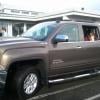
Was able to grab a picture of mine with the 1" front end lift. Excuse the appearance, it's still winter here. Ground has a slight slope, not real bad, but you can get a nice look at the relationship between the front and rear tires/wheelwells. Pic in my signature was a year ago when it was sitting stock ride height. 1" difference doesn't seem like a lot, but it does make a difference. Personally, don't think anyone can go wrong with 1" - 1.5" increase in front end ride height.

post-139324-0-53535100-1456154740_thumb.jpg

post-139324-0-53535100-1456154740_thumb.jpg

post-139324-0-53535100-1456154740_thumb.jpg

post-139324-0-53535100-1456154740_thumb.jpg

Edited by GRN69CHV
Posted

Was able to grab a picture of mine with the 1" front end lift. Excuse the appearance, it's still winter here. Ground has a slight slope, not real bad, but you can get a nice look at the relationship between the front and rear tires/wheelwells. Pic in my signature was a year ago when it was sitting stock ride height. 1" difference doesn't seem like a lot, but it does make a difference. Personally, don't think anyone can go wrong with 1" - 1.5" increase in front end ride height.

Stance looks perfect. The 1" is noticeable to those who appreciate such things. My wife called my truck a tank today and belongs to the group of people who don't appreciate the finer aspects of truck ownership! That's the great thing about these forums! BTW, what size tires do you have?

Posted

Tires are the stock Bridgestone Dueller RH-S 265/65-18 (31.56" tall). When these are gone, am considering going up one size to 275/65-18 (32" tall) or possibly even 265/70-18 (32.6" tall) which is what comes on the 2500.

Posted

Was able to grab a picture of mine with the 1" front end lift. Excuse the appearance, it's still winter here. Ground has a slight slope, not real bad, but you can get a nice look at the relationship between the front and rear tires/wheelwells. Pic in my signature was a year ago when it was sitting stock ride height. 1" difference doesn't seem like a lot, but it does make a difference. Personally, don't think anyone can go wrong with 1" - 1.5" increase in front end ride height.

Looks good. Anything between 1-1.5" is noticeable in my opinion. I've done 1.25" and 1.5" on past trucks and you can see the difference. The truck never rode any different either.

Posted

bilstein_5100_lift.jpg

The diagram on the right shows a dotted "maximum travel" line which is greater than "with Bilstein" shocks but less than "over extended down travel". It would be terrific to know what size spacer will take you to the maximum without going to the over extended zone. Does anyone know if there is a maximum figure or how we could find this out?

Posted

The diagram on the right shows a dotted "maximum travel" line which is greater than "with Bilstein" shocks but less than "over extended down travel". It would be terrific to know what size spacer will take you to the maximum without going to the over extended zone. Does anyone know if there is a maximum figure or how we could find this out?

This is why I only went with a 1"kit. Spacer block is 1/2" thick. When I unbolted the shock at lower mount points and lowered the control arm, there was just enough room to wiggle in the 1/2" spacer.

Posted

This is why I only went with a 1"kit. Spacer block is 1/2" thick. When I unbolted the shock at lower mount points and lowered the control arm, there was just enough room to wiggle in the 1/2" spacer.

Very interesting! This sounds almost too logical. I was hoping a 3/4" spacer (1.5" level) would make the safe zone!!

Posted

The diagram on the right shows a dotted "maximum travel" line which is greater than "with Bilstein" shocks but less than "over extended down travel". It would be terrific to know what size spacer will take you to the maximum without going to the over extended zone. Does anyone know if there is a maximum figure or how we could find this out?

Anything past factory is 'over extended'
Posted (edited)

Anything past factory is 'over extended'

Maybe the Bilstein diagram is misleading. My truck is used as a pleasure vehicle and does not need to be raked to allow for hauling heavy loads. I like the looks of a leveled truck however I will not compromise safety. Do you have information that would support why "anything past factory is over extended"? These trucks are designed to operate safely with the front moderately elevated, as this naturally happens when hauling. I don't understand how a 1 or 1.5 inch level can "over" do anything so I'm searching for information and advice from people such as you.

Edited by Donstar
Posted

It's physically and mechanically not possible to over extend the factory suspension unless you remove or modify (cut down) the upper bumpstop. Length between the upper and lower control arms is fixed at the spindle and ball joints. Same goes for suspension in full compression, upward travel limit is controlled by the lower bumpstop. I haven't had the shocks out on these trucks, but can tell you from experience, I have never had a suspension apart where the travel limits were controlled by the shock extension or compression with factory bumpstops in place.


PS: When I said there was approx 1/2" wiggle room, that's probably not a good explanation. I had to pry up on the shock to get a little spring compression and a little compression against the upper bumpstop to create the space needed. Didn't need a lot pressure but did need prying.

Posted

Maybe the Bilstein diagram is misleading. My truck is used as a pleasure vehicle and does not need to be raked to allow for hauling heavy loads. I like the looks of a leveled truck however I will not compromise safety. Do you have information that would support why "anything past factory is over extended"? These trucks are designed to operate safely with the front moderately elevated, as this naturally happens when hauling. I don't understand how a 1 or 1.5 inch level can "over" do anything so I'm searching for information and advice from people such as you.

Think of it this way. Put your truck up on a lift and let the front wheels come all the way down. Call that "fully extended". Anything past that is "over extended". As in the truck was never designed for the suspension to be pushed that far out/down.


Now install your spacer kit (whether it's a strut tower kit, or control arm spacer kit, doesn't matter). You've just pushed the suspension down another inch or two. You are now past what was "fully extended" and you are now, by definition, "over extended"


The blue drawing in the Bilstein picture is the exact opposite. Imagine you put your front suspension all the way up as far as it can go, under the front fenders of your truck. That's your full range on the compression side. Now stick that one or two inch spacer in there. You just lost some travel. I don't know if you call that "under-extended" or what.

Posted

The diagram on the right shows a dotted "maximum travel" line which is greater than "with Bilstein" shocks but less than "over extended down travel". It would be terrific to know what size spacer will take you to the maximum without going to the over extended zone. Does anyone know if there is a maximum figure or how we could find this out?

The whole red area is the 'over extended zone'

Posted (edited)

Think of it this way. Put your truck up on a lift and let the front wheels come all the way down. Call that "fully extended". Anything past that is "over extended". As in the truck was never designed for the suspension to be pushed that far out/down.


Now install your spacer kit (whether it's a strut tower kit, or control arm spacer kit, doesn't matter). You've just pushed the suspension down another inch or two. You are now past what was "fully extended" and you are now, by definition, "over extended"


The blue drawing in the Bilstein picture is the exact opposite. Imagine you put your front suspension all the way up as far as it can go, under the front fenders of your truck. That's your full range on the compression side. Now stick that one or two inch spacer in there. You just lost some travel. I don't know if you call that "under-extended" or what.

Are you pushing the suspension down more or are you compressing the spring? I visualize everything remaining in position while on the hoist. I see the extra pressure on the spring pushing the body upward when off the hoist.

Edited by Donstar
Posted

It's physically and mechanically not possible to over extend the factory suspension unless you remove or modify (cut down) the upper bumpstop. Length between the upper and lower control arms is fixed at the spindle and ball joints. Same goes for suspension in full compression, upward travel limit is controlled by the lower bumpstop. I haven't had the shocks out on these trucks, but can tell you from experience, I have never had a suspension apart where the travel limits were controlled by the shock extension or compression with factory bumpstops in place.


PS: When I said there was approx 1/2" wiggle room, that's probably not a good explanation. I had to pry up on the shock to get a little spring compression and a little compression against the upper bumpstop to create the space needed. Didn't need a lot pressure but did need prying.

This makes sense and is a good explanation but there certainly is some conflicting information out there!

Create an account or sign in to comment

You need to be a member in order to leave a comment

Create an account

Sign up for a new account in our community. It's easy!

Register a new account

Sign in

Already have an account? Sign in here.

Sign In Now

  • Latest Articles

  • Posts

    • 286,740 Mile Services   8/6/2026   New AC Compressor. Refrigerant oil and dye, evacuate and charge system.  New exhaust system from cat back.  New Iridium plugs plus replace #3 coil Repair/rewire headlamp wiring (passenger side) and replace all forward bulbs. Polish lenses of both assemblies.  Pull rear rotors, clean and adjust parking assembly. Inspect, clean and grease front calipers. Check pads and shoes.  4 wheel power bleed of brake system. Dot 4 Reset idle speed 50 rpm higher New Serpentine belt.    Will need new pads in the rear in about 5K more miles.    Tax Title and License out the door just short of a grand.    AC clutch had bitten the dust. 1 year warranty on the pick and save replacement. Thing will make a Polar Bear cry Uncle.  He spent quite some time on the wiring. It was in the harness and he does nothing half. I got off cheap. I have considerable more light down the road. Sylvania Silver Star replacements.  Gas seal between the porcelain and shell of plug #3 was blown, cooked the coil. That was the cold miss.  Love the new exhaust. I can sneak into the neighborhood again.  Nice to have a working parking brake again. Belle Tire never got it done. That was disappointing.    This was one of her bigger bills and still way cheaper than a payment even given the oil consumption. This thing cost me under a hundred a month in repairs and normal routine costs. What is my incentive to replace it? 🤔           
    • hello I recently bought a 2012 gmc 1500 with a 5.3 and have a AFM disabler on it I'm interested in doing a cam but I'm worried if I remove the AFM system I will fail smog does anyone have info if they are able to detect that or a work around to it (not talking about hot smogging) please let me know thank you  
    • Update. I started chasing down my symptoms. Started first with pulling valve covers and looked at everything. Everything looked good and couldn't hear or feel anything different. Then a compression test. 240 psi or really close on each cylinder. I was worried I was a tooth off of timing. Not bad for an engine with 173,000. Granted I did put new heads on. I sprayed water around the injector area to see if I could hear a change. Nothing. I hooked up my new hp tuner which I should have done in the first place but I don't really know what I'm looking at just yet but am learning. I noticed the fuel trims were way off so that told me I have to have either a bad injector or exhaust leak. New injectors, so I did the shop vac on blower and in the tail pipe. Sprayed soapy water and found the exhaust flange on the drivers side was leaking. I didn't think it would be that considereding I pulled the heads and left the manifolds attached. I did have the transmission replaced not long ago. They must have not seated them properly but I guess I didn't notice. I put in new gaskets on both sides. Which by the way isn't a bad job but I had a hard time getting them to seal right. Took two attempts. Reset the fuel trims and the ticking is gone, engine runs smooth and acceleration has improved. Got to feel the real difference with that stage 1 cam. It's not that big of a difference but it does add a little more. It feels like how the truck should have been from the factory.
    • Can it still be Assembled I?    Stribeck says that we need a certain amount of viscosity under conditions of load and velocity to prevent two surfaces of a know roughness from tearing each other asunder. And we have marketing trying to tell the masses that those two surfaced require less of that commodity due to more exact limits being placed on the same old clearances. We also know that there are limits to how hard something can before it becomes to brittle to be viable and to smooth to 'wet' the surface and that both of those conditions have been known and met since about the Second World War.    That viscosity value shook out at 10 centistokes at 212 F just under a hundred years ago.  Give this a look: [Anton Parr]     What is advertised is the Kinematic viscosity (mm2/s) or that which has been density adjusted but the value we are after is the dynamic viscosity (mPa.s) or true viscosity. You can see that this number is dependent on density thus base stock and temperature. You can also see that an SAE 30 doesn't reach that value in this example. However an SAE 30 that is at the upper end of the SAE 30 range; 12.5 cSt (mm2/s), might. 12.5 * .83 = 10.375 (mm2/s). If you could find an SAE 30 at the upper end these days.   Then there is the complication of viscosity modifiers or VII or VM, whatever you wish to call them. Polymers added to very thin base oils, perhaps 3 to 6 cP oils, that will meet the SAE *W30 spec at 'tested' shear rates and 100 C/212F  target temperature. So a polymer fortified base that is a fraction of the 10 cP requirement Stribeck insist upon.   This could be all well and good if those polymers didn't have two very problematic 'features'. They shear or loose viscosity both 1.) permanently and 2.) temporality. And they do both omitted in the advertised data with the distinct  purpose of deceiving the consumer of the actual operating state of the fluid. I've shown the example of Warren Oils COSTCO 10.91 cSt 5W30 formuation several times where the 100 C HTHS value is 6.9 cP!! That's the temporary shear down and with and SSI or shear stability index of 9.4 cSt. Note the intentional deception in using mixed units?    After a short while that 9.4 cSt oil has a viscosity corrected dynamic value of 7.8 cP. But as the SSI is still within the range of an SAE *W30 whose lower value is 9.3 cSt.    This allows them to continue to call this SAE 16 weight oil a 30 weight, the cake, and still meet the API requirements for fuel efficiency IMPROVEMENT mandated by the EPA. The eating of the cake. By the time you've worn out your motor doing the responsible thing by adhering to the warranty requirements, (the stick), you get deprived of the carrot, wear control. So sad, to bad.   So what can be done? Do I need actually say? [Anton Parr]       Even this must be monitored if the oil is on the low side and the VII an organic or you opt for a 0W40 with an even lighter base oil and more / higher MW VII. (Note the lower density of the 40 weight versus the SAE 30 mono-weight?)    There is another workaround. Temperature. An SAE *W30 run at a bulk temperature of between 180 and 195 F.    Being the belt and suspenders sort I am I do both. Run it cook and run it heavy.    In Part II I'll work the AW package. 
  • GM-Trucks.com Clubs

  • Popular Contributors

×
×
  • Create New...