Jump to content

Recommended Posts

Posted

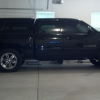
Hey guys I need some input on the subject. I have a 2020 Chevy Silverado 1500 lm2 z71 crew cab, 4" lift, air bags, Bilstein 5100 rear shocks, and 34" tires with a door rating of 9300lbs towing capacity. I've towed over a 1000 miles hooked up to a hummer h3 with 35's, winch bumper, and back seat drawer on a uhaul trailer before with ease from NC to TX in my truck. However I am looking to buy a 34' Travel Trailer with the following weight ratings.

"WILDWOOD 28VIEW TRAVEL TRAILER"

Dry Weight 7,753 lbs.

Payload Capacity 3,512 lbs.

GVWR 11,265 lbs.

Hitch Weight 1,065 lbs.


I never intended on towing it with the tanks full. I will be living out of it and will only be towed for moving from one camp to another, not frequent use. Should I still be safe as long as I don't exceed ~1800lbs in the trailer cargo?

I will also have a "Weigh Safe True Tow Middleweight Anti Sway Weight Distribution Hitch 6" Drop 2" Shank 12,500 lb Tow Rating"


Thank you!

20230527_135913.jpg

Posted

The way you modified your truck it will not tow it for long before you have issues

  • Like 2
Posted

In the case that this is not the one for me. What dry should I be looking for on a travel trailer?

Posted

Just remember that it could only tow 9,300lbs when stock. WIth the added weight of the lift, wheels and tires you are probably under 9,000lbs now. Getting the weight of the truck with nothing inside it and with a full tank of fuel would let you know what you can technically tow. But with it being lifted like that, I'd never exceed 8,000-8,500lbs but thats just me.


If you do plan to tow a travel trailer with it, I think the weight of the trailer itself can only be about 6,000lbs max when dry. That leaves you enough weight for to put over 1,000-1,500lbs in it safely.

  • Like 1
Posted (edited)

Look smaller.  Try a trailer that has a GVWR at or below 9000lbs.  


Edited by newdude
  • Like 1
Posted (edited)

So what I'm hearing here and the other forum is 5k to 6k dry with a max weight under 8k? Y'all talked me out of the 30+ foot models. 25-30 foot is what I'll look for. Also I'll be getting leaf springs rated for another 660lbs over the OEM, dunno if that helps my case (no more lift block). My tires are also load E (10 ply) with forged 3600lb rated wheels.

Edited by Ronjon
Posted

Aside from the weight, a half ton towing a 34 ft trailer is a scary proposition. Even with a Hensley hitch you would have a hard time controlling it. I had a 35 ft bumper pull at one time with a little over 1000# dry tongue weight and it was all the 2500HD Silverado crew cab (2005) could handle as far as control. 

  • Like 1
Posted
8 hours ago, Ronjon said:

So what I'm hearing here and the other forum is 5k to 6k dry with a max weight under 8k? Y'all talked me out of the 30+ foot models. 25-30 foot is what I'll look for. Also I'll be getting leaf springs rated for another 660lbs over the OEM, dunno if that helps my case (no more lift block). My tires are also load E (10 ply) with forged 3600lb rated wheels.


"Legally" it doesn't help.  The ratings of the truck are what they are.  So if for some reason you got scaled and were over (say an accident or something and they wanted weight), and you were over GCWR or over your payload...

  • Like 1
Posted

Do any of these trailers have brakes?  Also your increased tire size really hurts your trailering ability. While expensive, re-gearing your truck would help you a ton if you are dead set on pushing the limits. You would also probably want the TCM tuned at that point which adds additional cost. 

Posted

Have heard no mention of distance and terrain you'll be towing in. 


Properly setting up the weight distribution and sway control will go a long ways to making the set up feasible. It is not about the overall weight in a travel trailer, its the size, followed by tongue weight. Tongue weight will end up maxing out the GVWR of the truck first. 


Tire size on the truck is probably the biggest down side, followed by the lift.


The first thing you will run into towing a travel trailer is the engine RPM's will be high - all the time. MPG's will be low 8-9.


Your lift may actually help setting up the weight distribution shank because they are usually too low for a 1/2 ton. Overall the lift is going to be a negative though for stability and aerodynamics.


If you are traveling less than 1000 miles, not in severe terrain and no faster than 70mph you could probably make it work. 


I was able to manage a 35' (actual box measurement) travel trailer behind my 1/2 ton.


Be on the look out for all the "I'm gonna sue you if you crash into me and you're over weight people". 

  • Like 1
Posted

Your mileage may vary:  I am considering at some point in the future of moving twice a year.  For my wee Ubiquity, anything over 4500 lbs and I'll hire someone else to do it.  

  • Like 1
Posted

So what I've found that still checks my boxes for weight and amenities is the Solaire 2580RBSS. And thoughts? I'm going to have a lightweight island to put in the kitchen.

Screenshot_20241202_212949_Chrome.jpg

Posted

I've towed a similar size / weight model for the last 4.5 years with this truck.  Get a good WDH and you should be fine.  Load it up, weigh it, and adjust accordingly.  Mine comes in around 970lb on the hitch, and I mainly leave the bed empty.

  • Like 1
Posted

So what I've found that still checks my boxes for weight and amenities is the Solaire 2580RBSS. And thoughts? I'm going to have a lightweight island to put in the kitchen.


Not to be annoying but could you put your exact specs for both truck and trailer?

Create an account or sign in to comment

You need to be a member in order to leave a comment

Create an account

Sign up for a new account in our community. It's easy!

Register a new account

Sign in

Already have an account? Sign in here.

Sign In Now
  • Latest Articles

  • Posts

    • Welcome back! No, it definitely doesn't pass the sniff test. Even "ceasefire" needs an alternative definition these days.    $5.29 at Kroger today
    • That makes sense, and I think you are describing the real product problem. Capturing data is the easy part. If the owner or technician has to manually dig through five minutes of millisecond-level logs, the product has already failed. The device would be at the ECM harness, not at the OBD port, so I agree that data retrieval and event marking need to be thought through carefully. The way I am thinking about the architecture is: The recorder itself should not depend on a phone, app, Bluetooth, Wi-Fi, or cloud connection to capture the event. It should always keep a local rolling buffer and lock the event locally. A button, phone app, or small cabin device would only act as an event marker. If the driver feels a stumble and presses the button 10–30 seconds later, the pre-buffer has to already contain the useful data. For data retrieval, the practical options would be a sealed service USB lead, Wi-Fi download, or a phone/cabin companion device. I would not expect the owner to remove the ECM-side module or work with raw files directly. The cloud or AI side would be for interpretation, not for capturing the event. The truck may have no connection when the issue happens, so the evidence has to be saved locally first. After that, cloud processing could help decode the data, compare it against baselines, and generate a readable report. For the first version, I would keep the automatic triggers conservative and objective: driver event marker bus-off error passive voltage drop / brownout device reset FIFO or queue overflow a normally periodic message disappearing side-to-side communication mismatch, if the topology supports that For “learning normal,” I agree with your point, but I would not want to overclaim it as automatic root-cause diagnosis at first. A realistic first step would be learned baseline comparison for that specific vehicle and operating condition. For example, a value would only be compared against similar conditions: RPM range load / MAP throttle position gear / vehicle speed coolant and oil temperature battery voltage AFM/DFM state, if decoded and validated Then the report could flag things like: this periodic message disappeared compared with its normal timing this value deviated from this vehicle’s normal range under similar conditions the same abnormal pattern repeated after the same type of event the anomaly occurred together with voltage, oil-pressure, misfire, or communication changes But I would still call that “abnormal pattern detected,” not “replace this part,” unless there is enough validated repair data behind it. So the intended product would not be “here is a huge log.” It would need to be an event package: what triggered the capture how much pre/post data was preserved what changed before and after the event whether the device itself reset, overflowed, or saw a bus error selected graphs around the event raw data only as supporting evidence From your perspective, what would make this kind of report useful instead of just another datalog? For example: What are the top 5 parameters or events you would want highlighted first? Would you trust a learned baseline for that specific vehicle, or would you prefer fixed thresholds? How much false-positive flagging would be acceptable before you stopped looking at the reports? What would a one-page report need to show for an independent shop to take it seriously? For misfire, AFM/DFM, oil pressure, or U-code complaints, what would you want the tool to flag automatically?
    • 2024 Silverado 2500 HD LTZ grille no camera Parts list   84603331 84913656 84913657 84913654 84913655 84911567 84911568 85646092 85646093 85797921 85797922   11570637  x10-15   grille/bumper bolts 11546500  x10      grille clips 11571006  x10      push/retainer clips 11546454  x6       nut retainers 11611609  x6       M5 bolts 11610700  x6       molding/trim retainers
    • And use RA's 5% discount code if you buy from them.  google for the code, one is always available.
    • Just don't turn the steering wheel as much?
  • GM-Trucks.com Clubs

  • Popular Contributors

×
×
  • Create New...