Jump to content

Recommended Posts

Posted

So new UCAs is a good investment. Do you think the angle a 2-2.5 level puts on the CV axles is that detrimental?


I really don't know. Maybe some of the guys that have had them for a couple hundred thousand miles (GMT900 guys) can tell us if they've had problems. I suspect not. My old GMT800 (99 1/2) had 250,000 on it last time I saw it. No CV changes yet, but it was a 2500 at stock height. So, there's a baseline of a stocker.

Posted

My cousin has 140,000+ on his 2009 Sierra with a Rough Country 2.5" and had to replace one of them, but he attributes it some incident on a trail one night, not the leveling kit.

Posted

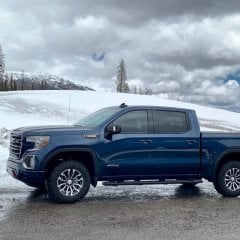
Got the work done at expert...Got a 2" level and could be happier ride is same as stock. Now just waiting to see what my mpg look like

  • Like 1
Posted

Got the work done at expert...Got a 2" level and could be happier ride is same as stock. Now just waiting to see what my mpg look like


Looks great with a 2" level. What was your height difference between front & back before the level?

Posted (edited)


Looks great with a 2" level. What was your height difference between front & back before the level?


Stock height on a double cab sierra, I was sitting at 36" front, 39.5" rear.

2" RC level left it at exactly 38" front and 39.5" rear.


From my experience and time on this forum it seems the shorter the cab the steeper the stock rake.

Crew Cab requires about 1.5-1.75" to look level (front raise only)

Double cab requires about 1.75-2.25" to look level (front raise only)

Single cab requires ???


The stock single cab long box seems to have the steepest rake from the factory - due to the weight spread i'm assuming that's why everyone here has different opinions. Also it depends if you are considering fender height vs box level vs body level etc.


I have the 2.5" rc kit in now on my double cab and it has a bit of rake - but it is a truck and I do haul things around in the back so that's what I was going for. A lot of people are opting out of the 1" rear increase on the crew cab because they are naturally more level from the factory.


Personally, when I see the nose of a truck higher in the air - even on those 200K+ SEMA builds I cringe. It's face down, a$$ up, not the other way around. Get it right

Edited by tanner709
Posted


Stock height on a double cab sierra, I was sitting at 36" front, 39.5" rear.

2" RC level left it at exactly 38" front and 39.5" rear.


From my experience and time on this forum it seems the shorter the cab the steeper the stock rake.

Crew Cab requires about 1.5-1.75" to look level (front raise only)

Double cab requires about 1.75-2.25" to look level (front raise only)

Single cab requires ???


The stock single cab long box seems to have the steepest rake from the factory - due to the weight spread i'm assuming that's why everyone here has different opinions. Also it depends if you are considering fender height vs box level vs body level etc.


I have the 2.5" rc kit in now on my double cab and it has a bit of rake - but it is a truck and I do haul things around in the back so that's what I was going for. A lot of people are opting out of the 1" rear increase on the crew cab because they are naturally more level from the factory.


Personally, when I see the noise of a truck higher in the air - even on those 200K+ SEMA builds I cringe. It's face down, a$$ up, not the other way around. Get it right

Tanner I'm with you I hate rake with a passion regardless that it's for towing, it is ugly and in attractive

I havea 14 with the 2.5 rc level an still have rake, I'm adding the performance accessories 3inch body lift an bell tech 1/2-1inch coil spring spacers at the same time, I have 14k on my truck no issues just want more.


Sent from my iPhone using Tapatalk

Posted


Stock height on a double cab sierra, I was sitting at 36" front, 39.5" rear.

2" RC level left it at exactly 38" front and 39.5" rear.


From my experience and time on this forum it seems the shorter the cab the steeper the stock rake.

Crew Cab requires about 1.5-1.75" to look level (front raise only)

Double cab requires about 1.75-2.25" to look level (front raise only)

Single cab requires ???


The stock single cab long box seems to have the steepest rake from the factory - due to the weight spread i'm assuming that's why everyone here has different opinions. Also it depends if you are considering fender height vs box level vs body level etc.


I have the 2.5" rc kit in now on my double cab and it has a bit of rake - but it is a truck and I do haul things around in the back so that's what I was going for. A lot of people are opting out of the 1" rear increase on the crew cab because they are naturally more level from the factory.


Personally, when I see the nose of a truck higher in the air - even on those 200K+ SEMA builds I cringe. It's face down, a$$ up, not the other way around. Get it right

What tires did the 2" allow you to clear? I'm looking at 305/60/20, 295/55/20, and maybe 33x12.5x20.

Posted

Gentleman , is $400 for a 2' level kit with alignment a good deal? I have 2 shops around $400..are parts pretty much all the same in terms of what they do ? The 2 shops worked with different parts.

Thanks in advance

Posted

@f8l vnm Depends on the kit/brand etc. but sounds about the average price. You could purchase the kit yourself and probably get it done cheaper


@5RWill, wish I could tell you but I didn't upgrade prior to the full 2.5" install.

Posted

Got my 2" level done for $126 done in less then 30 mins. But these guys do about 20 trucks a day for local dealers. Average in my area is about $200

0e459ea75ad5f3f157d3490249f9dd5d.jpg

1c06cfe9039caf59f7eb0f6208b996e5.jpg

  • Like 1
Posted

Got my 2" level done for $126 done in less then 30 mins. But these guys do about 20 trucks a day for local dealers. Average in my area is about $2000e459ea75ad5f3f157d3490249f9dd5d.jpg1c06cfe9039caf59f7eb0f6208b996e5.jpg

Looks good what size tires are you running?

Posted

Got my 2" level done for $126 done in less then 30 mins. But these guys do about 20 trucks a day for local dealers. Average in my area is about $2000e459ea75ad5f3f157d3490249f9dd5d.jpg1c06cfe9039caf59f7eb0f6208b996e5.jpg

So is that parts and labor and alignment. If so , that's a sweet deal. Both shops here do tons of trucks and they have quoted me $400


Do you have any before and after pics? You truck looks great. Love the silver

Create an account or sign in to comment

You need to be a member in order to leave a comment

Create an account

Sign up for a new account in our community. It's easy!

Register a new account

Sign in

Already have an account? Sign in here.

Sign In Now
  • Recently Browsing   0 members

    • No registered users viewing this page.
  • Forum Statistics

    250.4k
    Total Topics
    2.7m
    Total Posts
  • Member Statistics

    342,863
    Total Members
    8,960
    Most Online
    Bulldogger
    Newest Member
    Bulldogger
    Joined
  • Who's Online   5 Members, 1 Anonymous, 841 Guests (See full list)


  • Latest Articles

  • Posts

    • It added a cost layer to an already limited production supply. True that. 
    • Swap costs and supply/demand balance. When a barrel comes out of the ground the entire range of products are present but not all at the same percentage.    Breakdown of Refined Products The following table summarizes the approximate output from a standard 42-gallon barrel of crude oil: Product Type Gallons per Barrel Percentage of Total Gasoline 20 gallons 45% Diesel Fuel 9 gallons 21% Other Products 13 gallons 31%   Most of that diesel figure is 'straight run' or cut from the barrel. Gasoline 'cut from the barrel runs 0 to 20% at the crude. So in the crude unit there is more diesel the gasoline, usually.  The full refining experience however gives the tabled values. Ego there is half the diesel than gasoline after the 'first crack' That could be an FCC unit, or Isomax or....   Those units take heavy products and break the big ones into little ones. Those numbers are harder to get hold of but directionally it ends up the same.    Really light products are very profitable. Ethylene and Propylene to name two. Those are cracked from slightly heavier feeds like NG and Propane and Ethane. The cracker harshness determines the feed for distillation. Those feeds come from less profitable products like diesel and gasoline.    So...there is a swap cost. How much market is there TODAY and what crude am I running TODAY..... what is my process capable of always.    There is this as well. The USA uses allot more gasoline than it does diesel so in the cracker the process is tilted to gasoline production which....limits supply of diesel. OTR uses the most and it has different requirements than automotive and agricultural.  Limiting auto products.    You are correct however. It is less refined, just less of it. Allot less. 
    • Most thermostatically controlled ATF systems use a 'wax' pill just like the one in your water thermostat. They work on the expansion volume of the wax and the pill is constructed in such a way as to limit the travel to remain within that range. This means it has an opening temperature often called the 'cracking temperature' and a fully open temperature. For whatever reason oil is designated by it's fully open temperature and water by it's cracking temperature.    Between the two it the "Regulating Temperature" The entire range is about 20 F from closed to open. In your example the lower limit, opening point of 145 F then has a fully open temp of 165 F and a throttling temperature of 155 F.    Thing is, the throttling temperature needs two things to work properly. Enough system load high enough to reach the minimum and a heat sink (cooler/exchanger) large enough to prevent any load applied from exceeding the fully open temperature.    If your system exceeds the fully open temperature it is screaming MORE COOLER.    Here is the silly part of the whole thermostat system where the oil is cooled/heated by the radiator. Nothing is flowing to that system until the oil temperature reaches the cracking temperature unless it is equipped with a minimum flow bypass orifice or a bypass built into the seating surface of the plunger. That system meant to get it up to temp quicker isn't doing a thing until WORK drives if from ambient to cracking temp. One a cold winter day, like zero F, it may never get hotter than about 110 F. Sometimes not even that.    People forget or are young enough to not know that until this millennia transmissions were cooled by the radiator cold tank alone and without a thermostat at all.  In the 50's they weren't even cooled. OEMs learn everything the hard way.    When an OEM tells you the trans "Works best" between 175 F and 220 F it means works best for THEM. The transmission thermostat is fuel play. If you watch you trans temps like I do you will learn that it may take a hundred miles if you are not towing and not driving more than say 55-60 mph on a zero F day to even reach 120 F and it might sit there all day if it's colder. Yet if functions perfectly over about 100 F. It may need to get a bit warmer for the fuel and spark maps to go without an multiplier.    Worry more about too hot. Use a cooler large enough to put that thermostat in range.         
    • Around 2008 if memory serves they took sulfur out. That was when diesel went up. 
    • Question for you Grumpy, why is diesel so much more than gasoline? Seems to me that it may be slightly a little less refined than gas and it doesn't have 10% alcohol which presumably lowers the price of gas
  • GM-Trucks.com Clubs

  • Popular Contributors

×
×
  • Create New...