Jump to content

Recommended Posts

Posted

I remember asking at a spring shop if a 1.5 spacer kit has any negative impact on front suspension. He assured me that there is no potential for problems. GRN69CHV points out that a similar amount of lift is generated by loading the back of the truck. Again, I agree with GMC-AT that some rake is ideal from both looks and load carrying perspectives. I like to justify my modifications with some practical purpose. I never was fond of fake air-scoops on muscle cars nor do I care to make my 6cylinder people mover into something it is not. It left the factory designed to accommodate miscellaneous loads for commercial or personal uses. I do not need my truck to be always at the ready for a heavy load so, for me, looks trumps brawn!

Posted (edited)

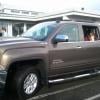
Was able to grab a picture of mine with the 1" front end lift. Excuse the appearance, it's still winter here. Ground has a slight slope, not real bad, but you can get a nice look at the relationship between the front and rear tires/wheelwells. Pic in my signature was a year ago when it was sitting stock ride height. 1" difference doesn't seem like a lot, but it does make a difference. Personally, don't think anyone can go wrong with 1" - 1.5" increase in front end ride height.

post-139324-0-53535100-1456154740_thumb.jpg

post-139324-0-53535100-1456154740_thumb.jpg

post-139324-0-53535100-1456154740_thumb.jpg

post-139324-0-53535100-1456154740_thumb.jpg

Edited by GRN69CHV
Posted

Was able to grab a picture of mine with the 1" front end lift. Excuse the appearance, it's still winter here. Ground has a slight slope, not real bad, but you can get a nice look at the relationship between the front and rear tires/wheelwells. Pic in my signature was a year ago when it was sitting stock ride height. 1" difference doesn't seem like a lot, but it does make a difference. Personally, don't think anyone can go wrong with 1" - 1.5" increase in front end ride height.

Stance looks perfect. The 1" is noticeable to those who appreciate such things. My wife called my truck a tank today and belongs to the group of people who don't appreciate the finer aspects of truck ownership! That's the great thing about these forums! BTW, what size tires do you have?

Posted

Tires are the stock Bridgestone Dueller RH-S 265/65-18 (31.56" tall). When these are gone, am considering going up one size to 275/65-18 (32" tall) or possibly even 265/70-18 (32.6" tall) which is what comes on the 2500.

Posted

Was able to grab a picture of mine with the 1" front end lift. Excuse the appearance, it's still winter here. Ground has a slight slope, not real bad, but you can get a nice look at the relationship between the front and rear tires/wheelwells. Pic in my signature was a year ago when it was sitting stock ride height. 1" difference doesn't seem like a lot, but it does make a difference. Personally, don't think anyone can go wrong with 1" - 1.5" increase in front end ride height.

Looks good. Anything between 1-1.5" is noticeable in my opinion. I've done 1.25" and 1.5" on past trucks and you can see the difference. The truck never rode any different either.

Posted

bilstein_5100_lift.jpg

The diagram on the right shows a dotted "maximum travel" line which is greater than "with Bilstein" shocks but less than "over extended down travel". It would be terrific to know what size spacer will take you to the maximum without going to the over extended zone. Does anyone know if there is a maximum figure or how we could find this out?

Posted

The diagram on the right shows a dotted "maximum travel" line which is greater than "with Bilstein" shocks but less than "over extended down travel". It would be terrific to know what size spacer will take you to the maximum without going to the over extended zone. Does anyone know if there is a maximum figure or how we could find this out?

This is why I only went with a 1"kit. Spacer block is 1/2" thick. When I unbolted the shock at lower mount points and lowered the control arm, there was just enough room to wiggle in the 1/2" spacer.

Posted

This is why I only went with a 1"kit. Spacer block is 1/2" thick. When I unbolted the shock at lower mount points and lowered the control arm, there was just enough room to wiggle in the 1/2" spacer.

Very interesting! This sounds almost too logical. I was hoping a 3/4" spacer (1.5" level) would make the safe zone!!

Posted

The diagram on the right shows a dotted "maximum travel" line which is greater than "with Bilstein" shocks but less than "over extended down travel". It would be terrific to know what size spacer will take you to the maximum without going to the over extended zone. Does anyone know if there is a maximum figure or how we could find this out?

Anything past factory is 'over extended'
Posted (edited)

Anything past factory is 'over extended'

Maybe the Bilstein diagram is misleading. My truck is used as a pleasure vehicle and does not need to be raked to allow for hauling heavy loads. I like the looks of a leveled truck however I will not compromise safety. Do you have information that would support why "anything past factory is over extended"? These trucks are designed to operate safely with the front moderately elevated, as this naturally happens when hauling. I don't understand how a 1 or 1.5 inch level can "over" do anything so I'm searching for information and advice from people such as you.

Edited by Donstar
Posted

It's physically and mechanically not possible to over extend the factory suspension unless you remove or modify (cut down) the upper bumpstop. Length between the upper and lower control arms is fixed at the spindle and ball joints. Same goes for suspension in full compression, upward travel limit is controlled by the lower bumpstop. I haven't had the shocks out on these trucks, but can tell you from experience, I have never had a suspension apart where the travel limits were controlled by the shock extension or compression with factory bumpstops in place.


PS: When I said there was approx 1/2" wiggle room, that's probably not a good explanation. I had to pry up on the shock to get a little spring compression and a little compression against the upper bumpstop to create the space needed. Didn't need a lot pressure but did need prying.

Posted

Maybe the Bilstein diagram is misleading. My truck is used as a pleasure vehicle and does not need to be raked to allow for hauling heavy loads. I like the looks of a leveled truck however I will not compromise safety. Do you have information that would support why "anything past factory is over extended"? These trucks are designed to operate safely with the front moderately elevated, as this naturally happens when hauling. I don't understand how a 1 or 1.5 inch level can "over" do anything so I'm searching for information and advice from people such as you.

Think of it this way. Put your truck up on a lift and let the front wheels come all the way down. Call that "fully extended". Anything past that is "over extended". As in the truck was never designed for the suspension to be pushed that far out/down.


Now install your spacer kit (whether it's a strut tower kit, or control arm spacer kit, doesn't matter). You've just pushed the suspension down another inch or two. You are now past what was "fully extended" and you are now, by definition, "over extended"


The blue drawing in the Bilstein picture is the exact opposite. Imagine you put your front suspension all the way up as far as it can go, under the front fenders of your truck. That's your full range on the compression side. Now stick that one or two inch spacer in there. You just lost some travel. I don't know if you call that "under-extended" or what.

Posted

The diagram on the right shows a dotted "maximum travel" line which is greater than "with Bilstein" shocks but less than "over extended down travel". It would be terrific to know what size spacer will take you to the maximum without going to the over extended zone. Does anyone know if there is a maximum figure or how we could find this out?

The whole red area is the 'over extended zone'

Posted (edited)

Think of it this way. Put your truck up on a lift and let the front wheels come all the way down. Call that "fully extended". Anything past that is "over extended". As in the truck was never designed for the suspension to be pushed that far out/down.


Now install your spacer kit (whether it's a strut tower kit, or control arm spacer kit, doesn't matter). You've just pushed the suspension down another inch or two. You are now past what was "fully extended" and you are now, by definition, "over extended"


The blue drawing in the Bilstein picture is the exact opposite. Imagine you put your front suspension all the way up as far as it can go, under the front fenders of your truck. That's your full range on the compression side. Now stick that one or two inch spacer in there. You just lost some travel. I don't know if you call that "under-extended" or what.

Are you pushing the suspension down more or are you compressing the spring? I visualize everything remaining in position while on the hoist. I see the extra pressure on the spring pushing the body upward when off the hoist.

Edited by Donstar
Posted

It's physically and mechanically not possible to over extend the factory suspension unless you remove or modify (cut down) the upper bumpstop. Length between the upper and lower control arms is fixed at the spindle and ball joints. Same goes for suspension in full compression, upward travel limit is controlled by the lower bumpstop. I haven't had the shocks out on these trucks, but can tell you from experience, I have never had a suspension apart where the travel limits were controlled by the shock extension or compression with factory bumpstops in place.


PS: When I said there was approx 1/2" wiggle room, that's probably not a good explanation. I had to pry up on the shock to get a little spring compression and a little compression against the upper bumpstop to create the space needed. Didn't need a lot pressure but did need prying.

This makes sense and is a good explanation but there certainly is some conflicting information out there!

Create an account or sign in to comment

You need to be a member in order to leave a comment

Create an account

Sign up for a new account in our community. It's easy!

Register a new account

Sign in

Already have an account? Sign in here.

Sign In Now

  • Latest Articles

  • Posts

    • Common failure.  You need to replace the fuel door housing.   The painted cover transfers over to the new housing.  To remove the old one there is 4 spots where you poke the plastic to release it.  
    • No such thing as regenerative braking on a pure ICE vehicle.     Regenerative braking is the re-capture of energy from electric motors and stores it in the battery pack.  So hybrids, PHEV and EVs have regenerative braking.     What you are seeing is the charging system changing modes is all.  Its likely entering charge mode for some sort of reason is all.  All of the charging modes will be listed below.   As for L10 vs D.  L10 turns off automatic grade braking.  L10 puts you in control of grade downshifts where in D it will automatically do it based on brake pedal position and other factors.  Otherwise L10 and D drive exactly the same aside from that one aspect.    Battery Sulfation Mode The BCM will enter this mode when the interpreted Generator output voltage is less than 13.2 V for 45 minutes. When this condition exists the BCM will enter Charge Mode for 2–3 minutes. The BCM will then determine which mode to enter depending on voltage requirements.   Charge Mode The BCM will enter Charge Mode when ever one of the following conditions are met:   Windshield wipers are ON for more than 3 s. Climate Control Voltage Boost Mode Request is true, as sensed by the HVAC control module via serial data. High speed cooling fan, rear defogger, and HVAC high speed blower operation can cause the BCM to enter the Charge Mode. The estimated battery temperature is less than 0°C (32°F). Battery State of Charge is less than 80%. Vehicle speed is greater than 145 km/h (90 mph) A current sensor malfunction exists. System voltage is determined to be below 12.56 V When any one of these conditions is met, the system will set targeted generator output voltage to a charging voltage between 13.9–15.5 V, depending on the battery state of charge and estimated battery temperature.   Fuel Economy Mode The BCM will enter Fuel Economy Mode when the estimated battery temperature is at least 0°C (32°F) but less than or equal to 80°C (176°F), the calculated battery current is less than 15 A and greater than −8 A, and the battery state-of-charge is greater than or equal to 80%. Its targeted generator output voltage is the open circuit voltage of the battery and can be between 12.5–13.1 V. When fuel economy mode is active, the generator is not charging, only maintaining open circuit battery voltage. The BCM will exit this mode and enter Charge Mode when any of the conditions described above are present.   Headlamp Mode The BCM will enter Headlamp Mode when ever the head lamps are ON (high or low beams). Voltage will be regulated between 13.9–14.5 V.   Start Up Mode When the engine is started the BCM sets a targeted generator output voltage of 14.5 V for 30 s.   Tow/Haul Mode (if applicable) Pressing the Tow/Haul Mode button located on the center stack, the vehicle system voltage is raised and the remote (non-vehicle) battery will be charged. Having the headlamps on will raise the system voltage and if the Tow/Haul button is applied it will not serve any purpose. The voltage is regulated between 13.9-14.5 V.      
    • Hello from Australia Just sharing that there is now a way to delete the active shutters entirely with just a plug in module. Opens up tons of room to light bars etc.
    • I have an observation and a question... 1) I watch the voltage closely because I have had to dial in the cut-in/cut-out voltages of the battery separator to my camper.  The "smart" charging drives me nuts.  Anyway, I noticed that when coasting for a while, and especially if lightly using the brakes (though not necessary), the voltage goes up from mid/high-13 volts to mid/high-14 volts.  Then it drops back down after stopping or going again.  Consistently!   The only explanation I can come up with is REGENERATIVE BRAKING!  Well, maybe that's a little bit of an exaggeration, but it's certainly free extra battery charging.   2) Driving on mountain roads I will use L and vary the max gear.  Things straighten out and I end up in L10.  Sometimes I leave it there for a while.  Is there any difference between L10 and D?   
  • GM-Trucks.com Clubs

  • Popular Contributors

×
×
  • Create New...