
Gas consumption while idling?

-
Recently Browsing 0 members
- No registered users viewing this page.
-
Forum Statistics
250.5k
Total Topics2.7m
Total Posts -
Member Statistics
342,902
Total Members8,960
Most Online
-
Who's Online 8 Members, 0 Anonymous, 469 Guests (See full list)
-
Latest Articles
-
Posts
-
By dieselfan1 · Posted
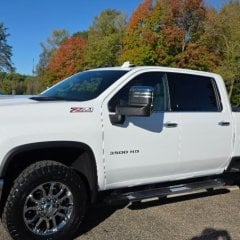
2026 3500HD. Mostly empty. Grocery getter. What tire pressure are you running for 37x12.50x20. I have 37x12.50R20 Toyo Open Country RT pro and been running around 55 lbs front and rear and it's too much. Tires are wearing more in the middle. Toyo says 45 front and 50 rear. Chalk test and it's still too much. I lowered it to 40 front 44 rear see what happens. -
 Enjoy the new truck, it’s a beauty. I’m glad you’re keeping the OBS, I love those old trucks.
 -
 With large equipment or deep mud it is more of a use the higher gear to avoid spinning tires, getting stuck because of spinning tires and doing damage to your machine. The idea is if you run out of torque before you spin tires you can still downshift for more torque. If you are just spinning your tires in the lowest available gear you are stuck and things break. Automatic transmissions, traction control and electronic transfer cases change the calculation a little as you the driver have less control over each piece.
 -
 are there any codes? with lots of rust, perhaps disconnect/clean both sides of the connection/examine cable ends (the wires) for corrosion going into the sheath & replace if necessary/reconnect ALL the power AND ground cables between the battery, engine, frame, cab, fuse box and starter charm.li (website) has a no-start diagnostic procedure you can work through to get it working.
 -
 Its no wonder you've gravitated to the oil types and brands you have in later years after trying certain brands and one being a specialty oil or at least very hard to come by up here and the other would have been a commonly found oil of the era and the vastly different outcomes as a result to using the vehicles in question the same distance for an OCI . It shows what marketing hype can do without actually having the product to back up the claims and that is no different now with the insane claims that are written on the side of a bottle of oil from some of the off the shelf oils. What has surprised me and I was already finding this out before I bought my truck with the GDI engine, that this newer fancy technology that seemingly would suggest better fuel economy/emissions with this high pressure spray of fuel is not in reality kind at all to the engine or at least the oils life. Yet they insist on claiming long OCI with this technology just like they did with the port or similar type fuel injection systems when in reality its a step back in oil life to have a GDI system. I think the mistake your making Grumpy is that your not sending your samples to Blackstone and getting the feel good glowing report that you can run it another 1000 or more miles and then send another sample where they say run it yet another 1000 miles and on and on it goes until your sending in something that looks a lot like road tar and then they may suggest you change your oil within the next 1000 miles 😆
-
-
GM-Trucks.com Clubs
-

Black Truck Club
Open Club · 612 members
-

White Truck Club
Open Club · 380 members
-

Canadian Owners Club
Open Club · 282 members
-

Red Truck Club
Open Club · 158 members
-

diesel 3.0
Open Club · 281 members
-

Texas Owner's Group
Open Club · 371 members
-

NorthSky Blue Club
Open Club · 118 members
-

Midwest Owner's Group
Open Club · 213 members
-

2015 Custom Sport Club
Open Club · 5 members
-

GM Snow Plowing Club HD
Closed Club · 14 members
-
-
Popular Contributors
-
.thumb.JPG.2c573de60d3a3a4407c7d92298db46dd.JPG)




Recommended Posts
Create an account or sign in to comment
You need to be a member in order to leave a comment
Create an account
Sign up for a new account in our community. It's easy!
Register a new accountSign in
Already have an account? Sign in here.
Sign In Now