Jump to content

Recommended Posts

Posted

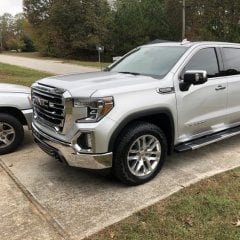
I currently have a 2014 GMC with 20 inch wheels. Looking at purchasing a 2020/2021 GMC and I really like the 22 in bright chrome wheels. Anyone with personal experience that went from a 20 inch wheel to a 22 inch wheel? Would like to know some Pros\Cons?

Posted

I had a 2018 Silverado and I decided on 20 inch wheels. I tow a race car trailer and it's a daily driver so I was worried about ride quality and towing characteristics of the 22 inch wheels. I now have a 2019 Silverado and went with the bright chrome 22 inch wheels and love them. It's a different truck but it rides and tows like a dream. 22 FTW

20191123_134329.jpg

  • Like 1
Posted

Don't let anyone tell you 22's ride harsh.  I've had many sets on many trucks.  Actually I can't tell any ride difference between the 20's I had and the 22's. The 2018 and down used a 285/45/22 and for 2019 it's a 285/50/22.  I'm running Michelin Premier LTX and the ride like a dream and balanced out with very little weight.

20190523_171901.jpg

20190523_170456.jpg

20190523_170113.jpg

  • Like 1
Posted

All things considered, the ride depends more on the quality of the tire than the size of the wheel.


Running stock Bridgestone Alenzas on my 22's. Optional 22's were a dealer installed option and dealer replaced steel transport wheels during prep and mounted tires on GM rims. First 1K rode a bit stiff and bouncy, position of the valve stems against tire marking shifted since delivery....seems some hard stops walked the rear tires around the rims. Dealer road force balanced and rides nice and smooth and the low profile 22's improve handling on this big boat to the level of a passenger car.

  • Like 1
Posted (edited)

If I lived in the city I might consider bigger wheels for a pavement queen truck.

Living in the rural mountains of Colorado I wouldn't have a wheel bigger than 18 inches.

I also believe the more side wall on a tire the more it absorbs road defects.

Not to mention the extra cost of bigger diameter tires.


:)

Edited by diyer2
  • Like 4
Posted

Same tire, one on a 20 and one on a 22, the 22 will ride a little harsher (hard to distinguish but it will, each person is different), it will be more susceptible to pot hole damage, it will be heavier which negatively affects acceleration and mpg (metal is heavier than rubber), it will respond to steering responses better so handling will be slightly improved but it will be more expensive in most cases. Going from a 22 to 18 is a much more drastic difference in ride. Straight smooth highway they will all ride the same, it is broken pavement that you will notice a difference. It is effectively like adding 5-10 lbs of air in your tires with the reduction in sidewall absorption. Some think larger looks better, I am in the other camp where prefer the look of some sidewall on my trucks along with the benefits that come with it...


Tyler 

  • Like 1
Posted

If you like the 22's, go with them. You are the one who will be driving the truck.


Had 20's on my 14, and 22's on the last two trucks, not a whole lot of difference in ride.

But, like mentioned above, tires make a huge difference, know this first hand swapping out the factory Bridgestone's on our Tahoe for a set of Michelin's. Night and day difference in every aspect.


If you plan on doing any off road driving, just be realistic in your expectations, which holds true for any combo you might have.

  • Like 1
Posted

As someone with 20" wheels I would recommend 18" wheels if you do anything off pavement. No comparison in ride quality. You will get a little more body roll with a 18" wheel. There are no benefits to a 22" whatsoever beside looks. They are heavier, ride worse, poorer economy, more expensive tires, less tire options, less rim protection, less traction etc. 

  • Like 2
Posted

On higher trim T1 trucks the overall wheel/tire size has increased by about 2", so you are about break-even on sidewall size with 2" bigger wheels.


Side-wall size probably contributes the most difference in ride quality and comfort given the same tire model and width.


If you stick with 20" wheels on the newer truck with the larger overall diameter, then it will look and ride more similar to the old truck with 18s.


Posted

I swapped from 20s to 17s with the same brand/model tire and got a slightly but noticeable better ride. 


I would never do 22s on a pickup, but the roads here I'm MN are harsher than what you'd find in the southern states due to the winters.  

Posted
I swapped from 20s to 17s with the same brand/model tire and got a slightly but noticeable better ride. 
 
I would never do 22s on a pickup, but the roads here I'm MN are harsher than what you'd find in the southern states due to the winters.  

I like the look of 22s much better, and the ride difference is extremely minimal if at all


Sent from my iPhone using Tapatalk
  • Like 1
Posted

22s are cool but they limit tire options a bunch.  I drive off road, so 20 is the biggest I was willing to go.  The sidewalls are still pretty big in my 20s

Posted

And to sum it up, it all depends upon your needs and pocket book.The profile of the tire changes with the size of the wheel and the larger the wheel size, the smaller the height of the sidewall so with tires from the same manufacturer the smaller wheel size is less susceptible to harshness and wheel damage because of the greater sidewall height to absorb road imperfections, off road travel conditions and the occasional pothole at the expense of reduced directional stability and performance.


Had aggressive treads 17's on the Goodyears on my Z71s and found them to be noisy and give a typical smooth, "snow tire" ride. Would be a great benefit on gravel, dirt, mud and deep snow all of which I never normally encounter, most I'd do was to go to a campground or maybe an off road jog on grassy hill areas or low brush in a wooded area. I don't even need them for snow because the main State roads/school bus routes are plowed before I can have breakfast, putter around and then clean the snow off the truck or SUV. Problem with these type of high profile, aggressive tread tires is loss of directional stability in a tight turn on a wet surface or a fast start from a stop sign or traffic light where the surface is compromised with a buildup of fluids from previously stopped vehicles. My early morning spins on paved back roads and hairpin turns would cause rear wheel slides even in Auto.


So this time there was no sense getting a Trail Boss with knobby tires, been there done that, so went for a pavement princess type setup on an RST with optional $3K larger 22" wheels w/ Bridgestone Alenza lower profile tires and normal sipe patterns on the tires which is more suitable to my driving situations. No doubt with a single speed transfer case and less aggressive tread pattern I'd have a problem with a heavy snow, mud or rock crawling but I'm not doing that......I sleep in for a heavy snow until roads are cleared and the harshest my tires will see is grass, crush and run, gravel or pavement. But the difference in handling and directional stability with large wheel, low profile tires is dramatic and worth every penny on this '19s wider, higher, greater turning radius boat. Even in 2WD with the low profile 22s I can now navigate the '19 on same teacups and hairpins at a higher speed without the rear slides I'd get on the '16 Z71 at lower speeds in Auto.


More fun to drive on the low profile 22s which is all I give a crap about. If I ever feel a need to go playing in the mud or go rock crawling I'll rent a Jeep with full coverage and knock the crap out of it.

  • Like 1
Posted

20's would have never done this.  Destroyed two that cost 3K to replace on my 16 Sierra

I'm getting new summer rims for my 2018 Silverodo but staying with the stock rim size. The 20's ride better and I don't have to worry about the curbs.

Like other stated way more tire choices. You can buy top of the line tires for the 20's for less then anything that fits the 22 inch rims.

spacer.png

Create an account or sign in to comment

You need to be a member in order to leave a comment

Create an account

Sign up for a new account in our community. It's easy!

Register a new account

Sign in

Already have an account? Sign in here.

Sign In Now
  • Recently Browsing   0 members

    • No registered users viewing this page.
  • Forum Statistics

    250.4k
    Total Topics
    2.7m
    Total Posts
  • Member Statistics

    342,745
    Total Members
    8,960
    Most Online
    twgraham
    Newest Member
    twgraham
    Joined
  • Who's Online   7 Members, 0 Anonymous, 515 Guests (See full list)


  • Latest Articles

  • Posts

    • Can someone tell me where the video processing module is in a 2023 Silverado? I'm getting conflicting results that it's in the front passenger area or the rear passenger area behind the seat.
    • Yes I agree, its what amounts to free advertising to let people know about his UOA testing company, and not that there is anything wrong with that but certainly that is a motivator for putting out videos about the science of oil as well as other topics such as oil and air filtration etc. The interesting part I found with his last video is not only the physics behind the reason for the varying wear due to a diesels working torque range causing more bearing load and that higher viscosity oil is of benefit, it was also that the chemistry behind the GM Dexos 0W-20 and the Mobil Dexos licensed 0W-20 are far enough apart that its showing up with a difference in wear even though the two oils are matched in viscosity and in that comparison viscosity was not having the finger pointed at it.    There are a few youtubers out there or one anyway that I have watched a bit of who has gone through the pains of accessing various countries manuals for a certain engine platform and while in the US/Canada it may say use 0W-20 or what have you for some Toyota product, in some other countries it sings a very different tune for the very same engine with the typical traditional oil viscosity/ambient temperature charts to help choose which oil viscosity is correct for the conditions the vehicle will be used in and in some cases its taken an engine in a US manual that states only use 0W-20 as per warranty coverage and yet that same engine in certain other countries may have up to a 15W-40 etc oil option that meets the spec. Another words the guy who is driving through Death Valley or Phoenix and south weather at 120f is often being fed a line of bs by the US system that has forced vehicle companies to restrict the warranty to a specific low viscosity oil for anterior reasons as well as the long drain interval suggestions.    Thankfully youtube is free ( yet anyway ) for viewers to sift through information and of course comes with the good and the bad ( truth and lies ) and we can choose to turn off/not watch what a person finds is bs or just not interested in the topic.         
    • No doubt... But, as someone who doesn't pay for his services, but who has provided a few views/clicks on his Youtube platform, the data around the Mobil oil testing I think does have some value including to "freeloaders" like me.   A lot of what he's doing is likely showing the OE's work in their oil selection, something that many of us had kind of assumed was true all along, a good balance of both excellent protection and efficiency.
    • Lake Speed is drumming up business for his company just by being in the spot-light so he has a vested interest in stoking the 0W-20 fire.  IMO  
    • I knew when I bought my truck that it had off road hill decent or craw control or whatever they call it and rolled my eyes at that but it gets throw on with other options my truck has, I just never had a heads up if the highway speed regular cruise setting had anything to do with the brakes and that took me by surprise. If you've ever been to the top of Pikes Peak and watched those ahead of you on the way down with their brake lights on constantly, one can guess they are probably not gearing down or not enough anyway if their vehicle will allow and a good reason their is a brake check spot part way down where they use an infra red heat gun to check how hot ones brakes are front and rear.    Your right that once one gets out of the front range by Denver and I've not been on that stretch of 285 between Denver and Fairplay myself but I know its high and Fairplay at 10000 feet, Buena Vista at 8000, it drops a bit from there but then your going back up and over the 11000 pass and Durango is at 6500 . So yes your definitely right that 6500 and a lot higher is the theme of going anywhere out in that direction from Denver but hey, the down hill sections give fantastic fuel mileage !.    I don't even look at the fuel pumps for what premium costs here, since I live on a farm and up to this point get fuel delivered I am rarely in front of a fuel pump and when I am, I am often using card lock bulk fuel stations so it tells me what the price is AFTER I buy the fuel. Looking up on gas buddy and converting to US gallons but in Canadian dollars, regular on average of the prices listed was around 5.95 and premium is around 7.00 . That was one reason I did not go for the 6.2 half ton aside from its lack of carrying/towing if one was going by the rule of using premium fuel and until recently one could only buy regular farm gas if playing the few cents off game for farm dyed fuel for a "farm licensed pickup". But yes I hear you on the fuel price difference and like the diesel theme with it often being more expensive then gas it doesn't have quite the charm to it either as it once did although right now here for some reason the price of diesel has come down more so its now inline with the price of regular gas. 
  • GM-Trucks.com Clubs

  • Popular Contributors

×
×
  • Create New...