Jump to content

Recommended Posts

Posted

A few weeks ago, while driving my 2011 GMC Yukon Denali (with 185,000 miles), the vehicle suddenly began making an obnoxious noise. There were no check engine lights, but the engine sounded rough. I later discovered that it was an AFM (Active Fuel Management) lifter failure on Cylinder 6. I was able to drive the vehicle home, and based on recommendations to avoid further damage, I parked it and began researching the issue.


With the help of a friend, I started diagnosing the problem. The first step was to confirm lifter failure by removing the valve cover. We identified the issue on the exhaust valve of Cylinder 6 its rocker arm was barely moving, indicating a lifter problem.


I tried the Marvel Mystery Oil method, following instructions to let the engine idle and drive it briefly, but after several attempts, it didn’t help. I realized that continuing to run the engine in this condition could cause more serious damage, so I decided to move forward with a proper repair. That meant rebuilding the head and replacing the lifters with new ones.


I proceeded with head removal steps by taking out the exhaust, intake, and finally the head where the problem was present. After removing the head and removing the lifter trays i laid out the lifters and confirmed one of them was soo stuck that it prevented the roller from moving:
image.thumb.jpeg.9ef947a8de13f3579d934eaeb1e05631.jpeg


image.thumb.jpeg.c86555298e34bd4b3a59ba75a3d79577.jpeg


I decided to proceed with using the AFM (Active Fuel Management) version of the lifters to repair the issue. I wasn’t entirely sure what kind of emissions or smog-related problems I might run into with California regulations during the next registration cycle, so I chose the path of least resistance and stuck with the original AFM setup.

The repair involved the following:

  • 4 brand-new OEM AFM lifters

  • 4 new standard lifters

  • New head gasket

  • New exhaust gasket and bolts

  • New head bolts

  • New valve cover gasket

  • New valve stem seals

  • Cylinder head machined (0.004” taken off) and deep cleaned

  • New dowel pins for head alignment

  • New lifter guide trays

  • New valley cover (valve lifter oil manifold) with new solenoids

  • New oil pressure sensor

  • Fuel injectors cleaned, flow-tested for spray pattern and resistance, with new O-rings installed

  • New intake manifold gasket

  • New ignition coils, coil wires, and spark plugs

All components were properly torqued according to specifications, including the head bolts which were torqued in three stages.


image.thumb.jpeg.a0c39247e822da9353f3b579964900aa.jpeg

image.thumb.jpeg.47301d68f55b09dcfc133e12231acfff.jpeg

image.thumb.jpeg.2d16fe6d795330cf770ae22b386071d2.jpeg

image.thumb.jpeg.2ad38b2165ef4f0a619c195843a7c23e.jpeg

image.thumb.jpeg.613e0f22342874a6155a307b126585f2.jpeg

image.thumb.jpeg.7ab474b1068d1d816f7aab1eba902ae2.jpeg


Now after all that I am getting the consistent Misfire on Cylinder 6, this is the Cylinder that had the original Lifter failure:

image.png.475376e35028e8c8d5a090195a07d383.png


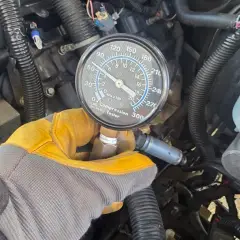
I tested the ignition coils and fuel injectors which are working as expected. I did compression test of the newly installed head getting the following readings (around ~180 for all 4 cylinders on rebuilt head):
20250526_160256.thumb.jpg.0d3af186b2db7bdb9847f9d9733736cd.jpg20250526_151126.thumb.jpg.901ae1e47ce952747d4d1bf70c3fe136.jpg20250526_150247.thumb.jpg.888a68621ccdac1f466833b74d1633f1.jpg


I was told that if the cylinder head wasn’t installed correctly, I wouldn’t get proper compression. At this point, I’m not sure what the root issue could be. The only thing that comes to mind is a possible problem with the wiring harness for the ignition coils or fuel injectors but that seems unlikely and a bit strange.

Has anyone experienced something similar or have any ideas on what the issue might be, given everything I’ve done so far?

If I can’t get this resolved, my next step will likely be a full rebuild and an AFM delete I'm ready to get rid of that system entirely and make this engine truly reliable again.


Thanks in advance for any help or input!


Posted (edited)

The cylinder head appeared to be in good condition, no warping or visible damage, just the typical carbon buildup. The valves held pressure and moved smoothly during inspection. I did make a minor scratch near the dowel guide while removing the head, but the machine shop corrected it. They fully inspected the head and confirmed it was in solid condition.

image.thumb.jpeg.ab0d461540d97d7c0989b06ed6288fe9.jpeg


image.thumb.jpeg.40adaef039eb0d848920ac87283c1825.jpeg
 

image.thumb.jpeg.79fc8aaff066abeeafcc0c951ec35449.jpeg

image.thumb.png.796458a680a8e01d880c23521be194a7.png

The camshaft was also in good shape. I didn’t allow the stuck lifter to run long enough to cause damage, and there were no scratches or grooves visible. I inspected the cam using a mechanic’s inspection camera while slowly and manually cranking the engine, and everything looked normal. There was also no sign of metal shavings or glitter in the oil or engine bay.

image.thumb.jpeg.41d46768812d340cd816305f9f3f1316.jpeg

Edited by DIY Mechanic Mike
Posted (edited)

Yesterday, I performed another round of compression tests. I removed all the spark plugs and pulled the two fuel injector fuses so the engine would only crank without firing. I also connected a battery charger to maintain voltage and ensure consistent cranking.
image.png.62ce7cce1ce60760bb0b6cecb60ca397.png

I tested all cylinders, and each one showed 210 PSI+ (some 235 PSI for some reason). However, Cylinder 6 behaved differently: while it initially built up to 210 PSI, it suddenly stopped compressing during continuous cranking and drop to zero. That indicated a problem with one of the valves on Cylinder 6.

Next, I removed the valve cover and observed the valvetrain while cranking the engine again. This time, I could clearly see that one of the valves on Cylinder 6 stopped moving entirely after a few cranks and stayed inactive. This valve has a new AFM lifter installed, I replaced all lifters on this cam with new ones during the rebuild.

I’ve been told this could be due to either a faulty solenoid in the valve valley cover or a bad OEM AFM lifter. However, i replaced the solenoid and I have new OEM AFM Lifter. I've even heard that GM's expensive original AFM lifters can fail unexpectedly, sometimes with very low mileage. What’s confusing is that this time the lifter isn’t physically stuck or making noise, rather, it seems to deactivate suddenly and causes the valve to stop moving entirely while cranking.

Edited by DIY Mechanic Mike
Posted

I’m preparing to remove the head again so I can pull the AFM lifter (probably all of the AFM lifters i bought since cant trust them now) and return it to NAPA Auto Parts. I’m confident everything was installed correctly and have verified that through multiple tests. I’ve also replaced several components, some of which were likely still functional, simply because it made sense during the diagnostic process and as a best practice.


This has turned into an expensive investigation (but less expensive than taking to mechanic), but with the flawed design of the AFM system, there’s no straightforward way to troubleshoot these issues. I’ve even been told that professional mechanics face the same headaches with these AFM-equipped engines. In some cases, they end up processing multiple warranty claims within a short period to replace the same faulty lifters.

I’ll need a new head gasket and a new set of head bolts. I don’t trust reusing the (new) used bolts, as they stretch during the torque process, which is especially concerning with aluminum block engines. It's not worth the risk.

Any recommendations before I proceed with the expensive process again are appreciated at the risk the new lifter will still deactivate, what else could be causing the lifter to go into deactivation when its visible active for short period of time maintaining pressure, I was told its when oil goes into the lifter during cranking and possible the spring on the lifter is not up to spec then activates which indicates a defective lifter. I don't know! 

Posted

The issue has been resolved, and the engine is now running well.
The problem was due to a single lifter that I had installed new into cylinder 6, its alignment was off by a few degrees and not properly seated into the designated grooves of the lifter tray. My Journey of fixing this thing is finally over until next time. Hopefully this will be useful for someone while I was also looking for some guidance myself yet figured it out through the tedious and painful process of taking this thing apart and putting back together 3 times.


For reference, here is an example of properly aligned lifters in a lifter tray:


image.png.0cfd05beb6ae5ce88f5b53deca3c896e.png

image.png.1b8b77afe07ac4f2011cb29544401505.png

Posted

FYI: You can test lifter installation with just the cylinder head installed, including rocker arms and pushrods, but without the exhaust manifold or spark plugs.

I temporarily installed the intake manifold only to connect the fuel line. There is no need to bolt it down, just place it in position. Although the fuel injectors are unplugged and their fuses removed, the fuel pump will still run during cranking and pressurize the fuel line. The intake helps contain any potential fuel and prevents it from spraying everywhere.

The engine was also drained of coolant, and there is no need to refill it just for cranking during these tests.

I used a battery charger to maintain power during cranking since the engine is not running and it is important to keep the battery healthy.

With this setup, I was able to observe the lifters and perform a compression test on each cylinder to confirm the head was installed correctly.

This method saves time and helps avoid the extra work of fully reassembling the engine only to find an issue that could have been caught much earlier in the process.

Create an account or sign in to comment

You need to be a member in order to leave a comment

Create an account

Sign up for a new account in our community. It's easy!

Register a new account

Sign in

Already have an account? Sign in here.

Sign In Now
  • Latest Articles

  • Posts

    • 87 down as low as $5.14 here... winning!
    • Progress... sort of.   Intake is disassembled, spider is out, fuel lines removed. Used a torch on the stripped screw with the lower intake off, much easier when I've got the intake sitting on my workbench, I made it talk. Walked right out with a pair of vice grips once it was nice and toasty hot.   New parts are piling up on my service cart waiting to be installed. Distributor, temperature sensor, new gaskets, fuel line kit, themostat, water neck.   My new pickle is I don't want to spend $600 on a replacement spider. I'm not sure IT is bad. I'm probably splitting hairs. Or it's $300 to send mine away and another 3 weeks of the truck just sitting. I have half a mind to assemble everything with the old spider to see if I can get away with just replacing the fuel pressure regulator to be safe. The obvious issue was the gushing high pressure fuel line which will be replaced. Getting to the spider really isn't that hard, and now I know what I'm doing , swapping it would be a breeze should it absolutely need one. Stupid, or smart?   The part that gives me pause is replacing the distributor. Well, it's already out. And I didn't mark it, whoopsie! Engine was at TDC when I removed it, I know that, so upon correct reinstall the metal tip on the rotor should point to the TDC mark on the distributor because that's where it was pointing on the old distributor. Worst case I'm a tooth off and have to re-stab it.   But then, what? I assume the truck will start. It doesn't appear the timing can be set. Here's the problem: These distributors can't be rotated but a degree or two, by design. What I read is Cam ****** needs to be -2 to +2 degrees, ideally at 0 (and checked/set above 1000 rpm). There should be enough wiggle to get that properly set, but checking the reported value is another potential issue. My Actron 9185 scanner says it supports enhanced GM PIDs and Cam ****** is one of them but it's unclear that I'll be able to correctly see it over OBD 1.5. I can see why people end up junking these things with life left in them. They're an absolute nightmare with tweener-year diagnostics/electronics and unobtanium parts.   Fingers crossed it starts and idles nicely. There can be hope, right? I'ma buy a lottery ticket the same day just in case.   Next steps..DO IT. I have not installed an intake before so I've been reading and watching a lot. Some say NO RTV except on china walls, some say DO RTV on water ports but not fuel/air intake. 1/4 or 3/8 bead on China walls? I think my strategy will be, obviously, RTV china walls with overlap on the gasket corners. Chapstick-style RTV the water ports. Leave intake ports dry. The only set of intake gaskets I could find locally are Edelbrock performance gaskets (uh...for an asthmatic 190hp V6? LOL) so we'll see how they do.   #NoToolLeftBehind. It took an hour, but my recovery mission for my deep 10mm socket was successful. It had rolled down the bellhousing and wedged itself between what I think are the fuel lines? I couldn't see it at all, but with a junk antenna I had laying around, I blindly went poking/sweeping for it, heard it clink, raised the truck, and caught a sliver glimpse of chrome with a flashlight way up there in Narnia. I had pushed it farther along the lines holding it captive, but within access of severely improvised tools, poking and cursing at it to finally knock it free to where I could get a fingertip on it to bring it home.    Not much to see.      
    • Thats crazy considering im right next door (Indiana)
    • For a limited time, retail and commercial accounts receive an AMSOIL Vinyl Tool Tray with their order of $500 or more when they use code TRAY726 at checkout. The promotion runs through July 21, 2026.   Order at https://syntheticadvantage.com   Want to use AMSOIL in your business or sell at your store, apply here.  https://www.amsoil.com/business-opportunities/?zo=521390  
    • It wouldn’t have happened if the government hadn’t mandated outrageous fuel mileage standards. It does very little for the consumer. It adds cost. Back during Covid there was a chip shortage. They gave a rebate for your truck if it didn’t have the chip to turn on cylinder deactivation. It was 50$ because at best you may see 1/2 a mile increase per gallon. Splitting hairs each fuel mileage trick wasn’t mandated. The government doesn’t do the engineering work and say use this until it’s already in use and they like it. The fuel mileage was mandated. And those add ons the results. There’s a mandate and they are the results.
  • GM-Trucks.com Clubs

  • Popular Contributors

×
×
  • Create New...