Jump to content

Recommended Posts

Posted

Okay so I have a 2008 GMC Sierra with 130 on a 5.3. It's my daily driver and now has some issues. Basically a misfire in cylinder 2 that I would like any good help with before I keep trying new things that might not work.

So the stalibitrak and traction control lights also flash and are on regularly which started at the same time. Meanwhile the engine light has flashed for a couple seconds but is usually solid. It is a p0302 misfire. So far I have cleaned the MAF, checked for leaks, changed all spark plugs, coils, and wires, ran some seafoam through it at the brake booster line and some in the gastank. I pulled the new spark plug after it didn't work for inspection and it was very carbon fouled after 3 days and very little driving. It runs good at higher speeds but idles rough and loud I would say klunky. Has not stalled. So Does anyone have any ideas before I keep changing things that are not the problem?

2008 Chevy Silverado/ 08 GMC Sierra 5.3

Posted

So you switched a known working coil pack to #2, put #2's coil on a known firing cylinder and code did not follow #2's coil pack? If that is ok, you have spark. That leaves fuel & compression.


Did test the fuel pressure?


Certain you do not have a vacuum leak?


Fouling indicates rich. Could be a leaky injector, or some type of vacuum leak and the ECM is putting more fuel in to compensate for all the unmetered air.


Did you do a compression check on #2?


I'd start with compression first, easiest and quickest to test.

Posted

Before blindly throwing money at the truck and hoping different new parts fix whatever the issue is, you may want to take it to a good garage and have them take a look at it for you. It gets quite expensive just randomly replacing parts. At least a good mechanic will be able to tell you what the exact problem is and what it's going to cost to get it fixed.


Sent from my iPhone6

via TapaTalk

Posted

I installed brand new plugs, coils, and wires.


I did not check fuel pressure or do a compression test. I will do a compression test tomorrow. Should I just change the injector first? I did put a scredriver up to it and can hear it clicking, not sure how accurate that method is.


Also I am hoping to fix this myself and not pay someone.


Thank you for the help.

Posted (edited)

Also, is it possible that gas is getting into the oil? It looks like there is a tad too much oil in there and when I last checked I don't think that was the case

Edited by bensaccount
Posted

plugged cat, leaky inj, gas in oil you can smell on dipstick most times as well as discoloration

Posted

Also, is it possible that gas is getting into the oil? It looks like there is a tad too much oil in there and when I last checked I don't think that was the case


I installed brand new plugs, coils, and wires.


I did not check fuel pressure or do a compression test. I will do a compression test tomorrow. Should I just change the injector first? I did put a scredriver up to it and can hear it clicking, not sure how accurate that method is.


Also I am hoping to fix this myself and not pay someone.


Thank you for the help.


If you have access to a fuel pressure gauge and a compression gauge do those first. No sense in buying a new injector without looking at those first. If compression is done, an injector is not going to help. Have you had any valve clatter?


Just to double check your coil and this is highly unlikely, but swap it with known working cylinder. This will eliminate all possibilities about not having good spark. Did you test to see if you have voltage at the coil pack? Maybe something is electrical is broken upstream from the coil.


Then research the proper way to troubleshoot an injector. I'm not going to tell you to throw an injector in and hope that it cures it.

Posted


If you have access to a fuel pressure gauge and a compression gauge do those first. No sense in buying a new injector without looking at those first. If compression is done, an injector is not going to help. Have you had any valve clatter?


Just to double check your coil and this is highly unlikely, but swap it with known working cylinder. This will eliminate all possibilities about not having good spark. Did you test to see if you have voltage at the coil pack? Maybe something is electrical is broken upstream from the coil.


Then research the proper way to troubleshoot an injector. I'm not going to tell you to throw an injector in and hope that it cures it.

I have new plugs, coils and wires, and re swapped them again so those are good. Although the new plug is getting carbon fouled super quick. I am going to grab the stuff for the tests now. What is Valve clatter? It definitely makes some knocking noise on idle that goes away or becomes indistinguishable when driving. Could be electrical upstream I don't know.

Posted

I have new plugs, coils and wires, and re swapped them again so those are good. Although the new plug is getting carbon fouled super quick. I am going to grab the stuff for the tests now. What is Valve clatter? It definitely makes some knocking noise on idle that goes away or becomes indistinguishable when driving. Could be electrical upstream I don't know.

When the truck is cold and first started does it loudly clatter. What I'm getting at it is the possibly of a stuck lifter. If you have a stuck lifter you would know it. It will clack very loudly then as the oil pressure builds it pumps up the lifter and the clacking stops.


You need to also get a volt meter and check to see if you have the proper voltage at the coil. I don't know what it should be or where to plug your volt meter in, but you need to eliminate that as well. Do some google research on GM coil pack troubleshooting. You can also get an inline spark tester that will show if the cylinder is firing.


If you hook the compression gauge up and you show low compression, then stop there. If compression is good, you need to determine if you have a fuel problem or electrical. Once you determine you have good voltage to the coil pack that eliminates spark. Then start going down the fuel tree. Good pressure, etc. I'm not sure if a vacuum leak would be fouling just on one cylinder. Could not hurt to hook a vacuum gauge up and see what vacuum you are pulling. One of the more experienced guys can chime in here, if you have a broken or weakened valve spring that will show up on the vacuum gauge. A vacuum leak would cause the engine to dump more gas in causing a fouling problem but not sure if that hold true. It is weird that it is only on one cylinder.

Posted (edited)


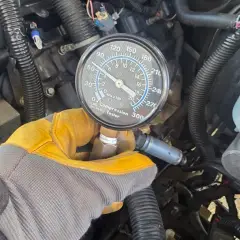
Okay compression test shows me at about 120-135k so that looks good. I only did a dry test, 3 runs on the offending cylinder. I have new plugs, new wires, new coil. Did a full synthetic oil change with a K and N filter. Now I can hear the spark plug working when I put a 1/2 piece of copper pipe up to it, is that good enough or do I need to do a voltage test as well?

If definitely DOES make some rattling noise on idle sometimes. Goes away when driving. Would the lifters cause low compression though?

Edited by bensaccount
Posted

Used a spark tester, whatever it is called, and that is good.


Interesting note, it does idle rougher than it used to and when I disconnect the power plug to the injector on cylinder 2, it runs the same. But it has spark, and has compression, and you can hear the injector working if you put a 1/2 piece of copper pipe up to it.

Posted

Someone can correct me if I'm wrong, but I thought stock compression should be at 170-190. My 2004 Silverado shop manual says 100 is the minimum. But the differential between the cylinder with the highest compression and the lowest should be no more than 70%.


Hook an inline spark tester and see if you are getting fire. Eliminate spark first, then move to fuel. I've never seen anyone use a 1/2" copper pipe to test for proper ignition. I'm a good ole' boy for sure, but you need some tools to make a proper diagnosis or you can buy parts until you luck out. You still have not figured out if you are getting spark. Just because you put a new plug, wire, and coil pack on does not guarantee you will have spark. Eliminate spark then move on.

Posted

Used a spark tester, whatever it is called, and that is good.


Interesting note, it does idle rougher than it used to and when I disconnect the power plug to the injector on cylinder 2, it runs the same. But it has spark, and has compression, and you can hear the injector working if you put a 1/2 piece of copper pipe up to it.

Now that you know you have spark, you need to troubleshoot the injector. I'm sure there are tests for that online. I suggest you hunt one of those down.

Posted

Someone can correct me if I'm wrong, but I thought stock compression should be at 170-190. My 2004 Silverado shop manual says 100 is the minimum. But the differential between the cylinder with the highest compression and the lowest should be no more than 70%.


Hook an inline spark tester and see if you are getting fire. Eliminate spark first, then move to fuel. I've never seen anyone use a 1/2" copper pipe to test for proper ignition. I'm a good ole' boy for sure, but you need some tools to make a proper diagnosis or you can buy parts until you luck out. You still have not figured out if you are getting spark. Just because you put a new plug, wire, and coil pack on does not guarantee you will have spark. Eliminate spark then move on.

I did verify spark, my brother checked with some tool he put in (he works on cars for living but has 6 kids and very little time). For sure spark. Also the 1/2 copper pipe thing is based off a youtube video of someone using a screwdriver to test the injectors.

The copper pipe worked much better than my screwdriver.
Posted

Now that you know you have spark, you need to troubleshoot the injector. I'm sure there are tests for that online. I suggest you hunt one of those down.

Replaced the Injector, and the noise is lessened, the truck is driving better, but the light still came on for a split second. I am hoping it is fixed but I just had some glitch. Going to drive it in a few again.

Create an account or sign in to comment

You need to be a member in order to leave a comment

Create an account

Sign up for a new account in our community. It's easy!

Register a new account

Sign in

Already have an account? Sign in here.

Sign In Now
  • Latest Articles

  • Posts

    • Have considered installing a DC to DC charger in your camper to replace your isolator?  
    • Common failure.  You need to replace the fuel door housing.   The painted cover transfers over to the new housing.  To remove the old one there is 4 spots where you poke the plastic to release it.  
    • No such thing as regenerative braking on a pure ICE vehicle.     Regenerative braking is the re-capture of energy from electric motors and stores it in the battery pack.  So hybrids, PHEV and EVs have regenerative braking.     What you are seeing is the charging system changing modes is all.  Its likely entering charge mode for some sort of reason is all.  All of the charging modes will be listed below.   As for L10 vs D.  L10 turns off automatic grade braking.  L10 puts you in control of grade downshifts where in D it will automatically do it based on brake pedal position and other factors.  Otherwise L10 and D drive exactly the same aside from that one aspect.    Battery Sulfation Mode The BCM will enter this mode when the interpreted Generator output voltage is less than 13.2 V for 45 minutes. When this condition exists the BCM will enter Charge Mode for 2–3 minutes. The BCM will then determine which mode to enter depending on voltage requirements.   Charge Mode The BCM will enter Charge Mode when ever one of the following conditions are met:   Windshield wipers are ON for more than 3 s. Climate Control Voltage Boost Mode Request is true, as sensed by the HVAC control module via serial data. High speed cooling fan, rear defogger, and HVAC high speed blower operation can cause the BCM to enter the Charge Mode. The estimated battery temperature is less than 0°C (32°F). Battery State of Charge is less than 80%. Vehicle speed is greater than 145 km/h (90 mph) A current sensor malfunction exists. System voltage is determined to be below 12.56 V When any one of these conditions is met, the system will set targeted generator output voltage to a charging voltage between 13.9–15.5 V, depending on the battery state of charge and estimated battery temperature.   Fuel Economy Mode The BCM will enter Fuel Economy Mode when the estimated battery temperature is at least 0°C (32°F) but less than or equal to 80°C (176°F), the calculated battery current is less than 15 A and greater than −8 A, and the battery state-of-charge is greater than or equal to 80%. Its targeted generator output voltage is the open circuit voltage of the battery and can be between 12.5–13.1 V. When fuel economy mode is active, the generator is not charging, only maintaining open circuit battery voltage. The BCM will exit this mode and enter Charge Mode when any of the conditions described above are present.   Headlamp Mode The BCM will enter Headlamp Mode when ever the head lamps are ON (high or low beams). Voltage will be regulated between 13.9–14.5 V.   Start Up Mode When the engine is started the BCM sets a targeted generator output voltage of 14.5 V for 30 s.   Tow/Haul Mode (if applicable) Pressing the Tow/Haul Mode button located on the center stack, the vehicle system voltage is raised and the remote (non-vehicle) battery will be charged. Having the headlamps on will raise the system voltage and if the Tow/Haul button is applied it will not serve any purpose. The voltage is regulated between 13.9-14.5 V.      
    • Hello from Australia Just sharing that there is now a way to delete the active shutters entirely with just a plug in module. Opens up tons of room to light bars etc.
    • I have an observation and a question... 1) I watch the voltage closely because I have had to dial in the cut-in/cut-out voltages of the battery separator to my camper.  The "smart" charging drives me nuts.  Anyway, I noticed that when coasting for a while, and especially if lightly using the brakes (though not necessary), the voltage goes up from mid/high-13 volts to mid/high-14 volts.  Then it drops back down after stopping or going again.  Consistently!   The only explanation I can come up with is REGENERATIVE BRAKING!  Well, maybe that's a little bit of an exaggeration, but it's certainly free extra battery charging.   2) Driving on mountain roads I will use L and vary the max gear.  Things straighten out and I end up in L10.  Sometimes I leave it there for a while.  Is there any difference between L10 and D?   
  • GM-Trucks.com Clubs

  • Popular Contributors

×
×
  • Create New...