
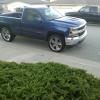
Marv88 2016 Silverado LS Regular Cab 5.3L
-
Similar Content
-
*UPDATE WITH PHOTOS* For anyone wanting OE metal skid plates for their 2019-2026 Silverado 1500 or Sierra 1500
By s10dragracer888,
- 14 replies
- 2,315 views
-
UPDATED WITH RATTLE VIDEO**WHAT is this noise? 2024 Silverado 1500 WT, 5.3 1 2 3 4
By s10dragracer888,
- 53 replies
- 12,345 views
-
- 0 replies
- 1,484 views
-
- 1 reply
- 4,434 views
-
- 6 replies
- 14,270 views
-
-
Recently Browsing 0 members
- No registered users viewing this page.
-
Forum Statistics
250.4k
Total Topics2.7m
Total Posts -
Member Statistics
342,758
Total Members8,960
Most Online
-
Who's Online 5 Members, 0 Anonymous, 2,097 Guests (See full list)


-
Latest Articles
-
Posts
-
 Welcome back! No, it definitely doesn't pass the sniff test. Even "ceasefire" needs an alternative definition these days. $5.29 at Kroger today
 -
 That makes sense, and I think you are describing the real product problem. Capturing data is the easy part. If the owner or technician has to manually dig through five minutes of millisecond-level logs, the product has already failed. The device would be at the ECM harness, not at the OBD port, so I agree that data retrieval and event marking need to be thought through carefully. The way I am thinking about the architecture is: The recorder itself should not depend on a phone, app, Bluetooth, Wi-Fi, or cloud connection to capture the event. It should always keep a local rolling buffer and lock the event locally. A button, phone app, or small cabin device would only act as an event marker. If the driver feels a stumble and presses the button 10–30 seconds later, the pre-buffer has to already contain the useful data. For data retrieval, the practical options would be a sealed service USB lead, Wi-Fi download, or a phone/cabin companion device. I would not expect the owner to remove the ECM-side module or work with raw files directly. The cloud or AI side would be for interpretation, not for capturing the event. The truck may have no connection when the issue happens, so the evidence has to be saved locally first. After that, cloud processing could help decode the data, compare it against baselines, and generate a readable report. For the first version, I would keep the automatic triggers conservative and objective: driver event marker bus-off error passive voltage drop / brownout device reset FIFO or queue overflow a normally periodic message disappearing side-to-side communication mismatch, if the topology supports that For “learning normal,” I agree with your point, but I would not want to overclaim it as automatic root-cause diagnosis at first. A realistic first step would be learned baseline comparison for that specific vehicle and operating condition. For example, a value would only be compared against similar conditions: RPM range load / MAP throttle position gear / vehicle speed coolant and oil temperature battery voltage AFM/DFM state, if decoded and validated Then the report could flag things like: this periodic message disappeared compared with its normal timing this value deviated from this vehicle’s normal range under similar conditions the same abnormal pattern repeated after the same type of event the anomaly occurred together with voltage, oil-pressure, misfire, or communication changes But I would still call that “abnormal pattern detected,” not “replace this part,” unless there is enough validated repair data behind it. So the intended product would not be “here is a huge log.” It would need to be an event package: what triggered the capture how much pre/post data was preserved what changed before and after the event whether the device itself reset, overflowed, or saw a bus error selected graphs around the event raw data only as supporting evidence From your perspective, what would make this kind of report useful instead of just another datalog? For example: What are the top 5 parameters or events you would want highlighted first? Would you trust a learned baseline for that specific vehicle, or would you prefer fixed thresholds? How much false-positive flagging would be acceptable before you stopped looking at the reports? What would a one-page report need to show for an independent shop to take it seriously? For misfire, AFM/DFM, oil pressure, or U-code complaints, what would you want the tool to flag automatically?
 -

By scotthvac.net · Posted
2024 Silverado 2500 HD LTZ grille no camera Parts list 84603331 84913656 84913657 84913654 84913655 84911567 84911568 85646092 85646093 85797921 85797922 11570637 x10-15 grille/bumper bolts 11546500 x10 grille clips 11571006 x10 push/retainer clips 11546454 x6 nut retainers 11611609 x6 M5 bolts 11610700 x6 molding/trim retainers -
 And use RA's 5% discount code if you buy from them. google for the code, one is always available.
 -
-
-
GM-Trucks.com Clubs
-

Black Truck Club
Open Club · 612 members
-

White Truck Club
Open Club · 380 members
-

Canadian Owners Club
Open Club · 282 members
-

Red Truck Club
Open Club · 156 members
-

diesel 3.0
Open Club · 279 members
-

Texas Owner's Group
Open Club · 371 members
-

NorthSky Blue Club
Open Club · 118 members
-

Midwest Owner's Group
Open Club · 212 members
-

2015 Custom Sport Club
Open Club · 5 members
-

GM Snow Plowing Club HD
Closed Club · 14 members
-
-
Popular Contributors
-



Recommended Posts
Create an account or sign in to comment
You need to be a member in order to leave a comment
Create an account
Sign up for a new account in our community. It's easy!
Register a new accountSign in
Already have an account? Sign in here.
Sign In Now